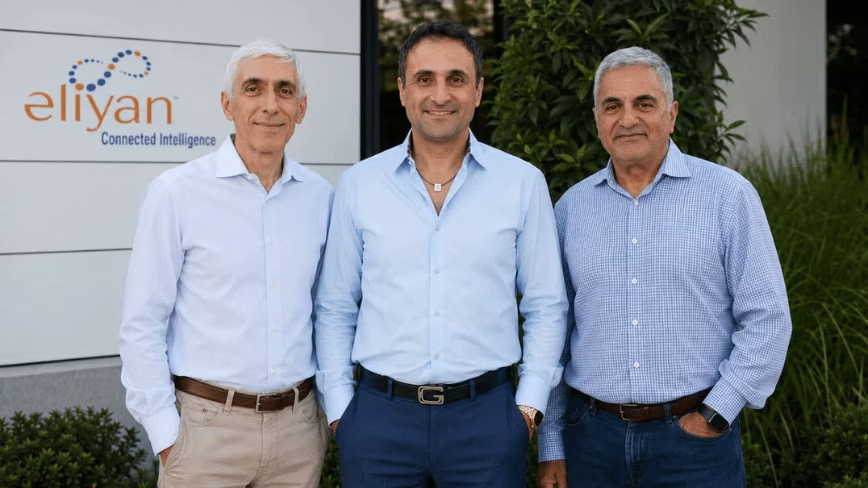
For three years, the AI race has been a race for faster chips. Eliyan just became a $1bn company by pointing out that the chips are now too fast for their own wires. The Santa Clara startup said it closed an oversubscribed $145m Series C at a $1bn valu…
Dave, a New AI-Powered Tool for Sellers, Helps Resolve 54% of Their Cases and Efficiently Manages Demand Spikes During AAA Game Launches. Now available in 180 countries, it has reduced the number of tickets submitted to Seller’s Support teams by 30%. G…
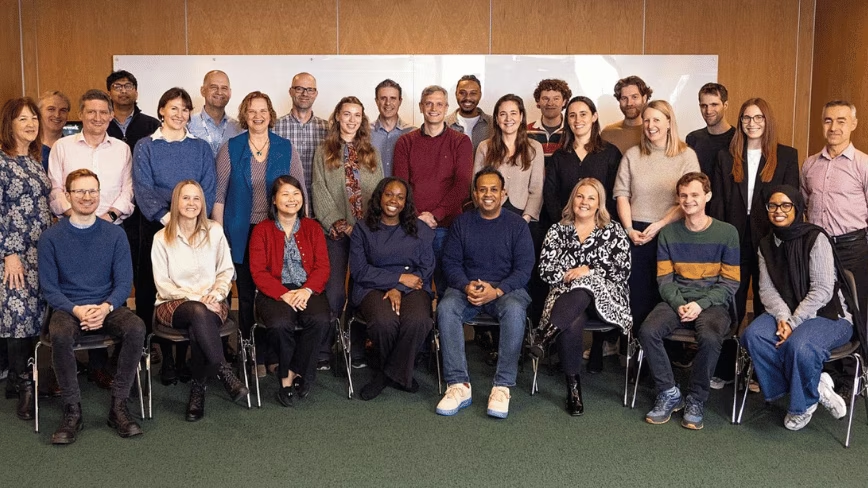
Most AI imaging startups build one model per disease. A Cambridge company has raised $20m to build a single model for the whole chest. Then it can spin the rest out of that. Qureight makes AI imaging tools for lung and heart clinical trials. It closed …

Less than a year ago, AlphaFold won Google DeepMind a Nobel Prize. Now DeepMind has taken the team that built it apart. The lab has reassigned most of the original AlphaFold-paper authors over the past year, the Financial Times reported. Nearly a quart…
For the past two years, the AI industry has focused on making models smarter. Every new release promises better reasoning, longer context windows, or more capable autonomous agents. Increasingly, people assume that software won’t just answer questions;…
Richard Socher’s new AI lab has just made an unusual bet with its money. Recursive has committed about $410m to a single, multi-year cloud contract with Amazon Web Services. That is roughly two-thirds of everything it has raised. The company left steal…
The enterprise AI market is moving into a new phase. As companies shift from experimenting with individual AI applications to deploying agents across business operations, the challenge is increasingly less about giving models access to information and …

Anthropic announced on Monday that Claude Mythos Preview has discovered mathematical weaknesses in two cryptographic algorithms. The first substantially weakens HAWK, a post-quantum digital signature scheme under review by NIST, by cutting its effectiv…

Epitel has raised $26m in a Series B round to expand a wireless EEG system that patients wear at home. Catalyst Health Ventures and Genoa Ventures co-led the round. The Salt Lake City company says it will spend the money on sales, marketing and distrib…
Australian Prime Minister Anthony Albanese’s proposed national environmental and energy controls for the country’s A$150 billion data centre pipeline hit their first obstacle on Tuesday, when two jurisdictions declined to back them. Federal, state and …