“Cosmic archaeologists” have discovered an iron-deficient second-generation star, which provides evidence of how ancient stars enriched their successors.
…
With the help of an extremely powerful telescope deep underground in Japan, astronomers may be able to catch a glimpse of ghost particles from long-dead stars.
…
As binary neutron stars spiral around each other to merge, their gravitational tidal forces distort each other’s shape and structure, potentially revealing clues as to what lies within them.
…
So, why is it that Orion is not always visible in the night sky, and certainly not in the same location month after month, while the Big Dipper always is?
…
Astronomers have tracked a powerful blast of radiation back to its source, finding a neutron star collision within colliding galaxies.
…
Astronomers have discovered that the birth of neutron stars with magnetic fields trillions of times stronger than Earth’s magnetosphere is the “magic trick” behind superbright supernovas.
…
Our sun and a host of “solar twins” may have migrated away from the core of the Milky Way galaxy together long ago, potentially making the solar system more hospitable to life.
…
A new image captured by the Very Large Telescope reveals stars and gas orbiting the “invisible giant” at the heart of our galaxy.
…
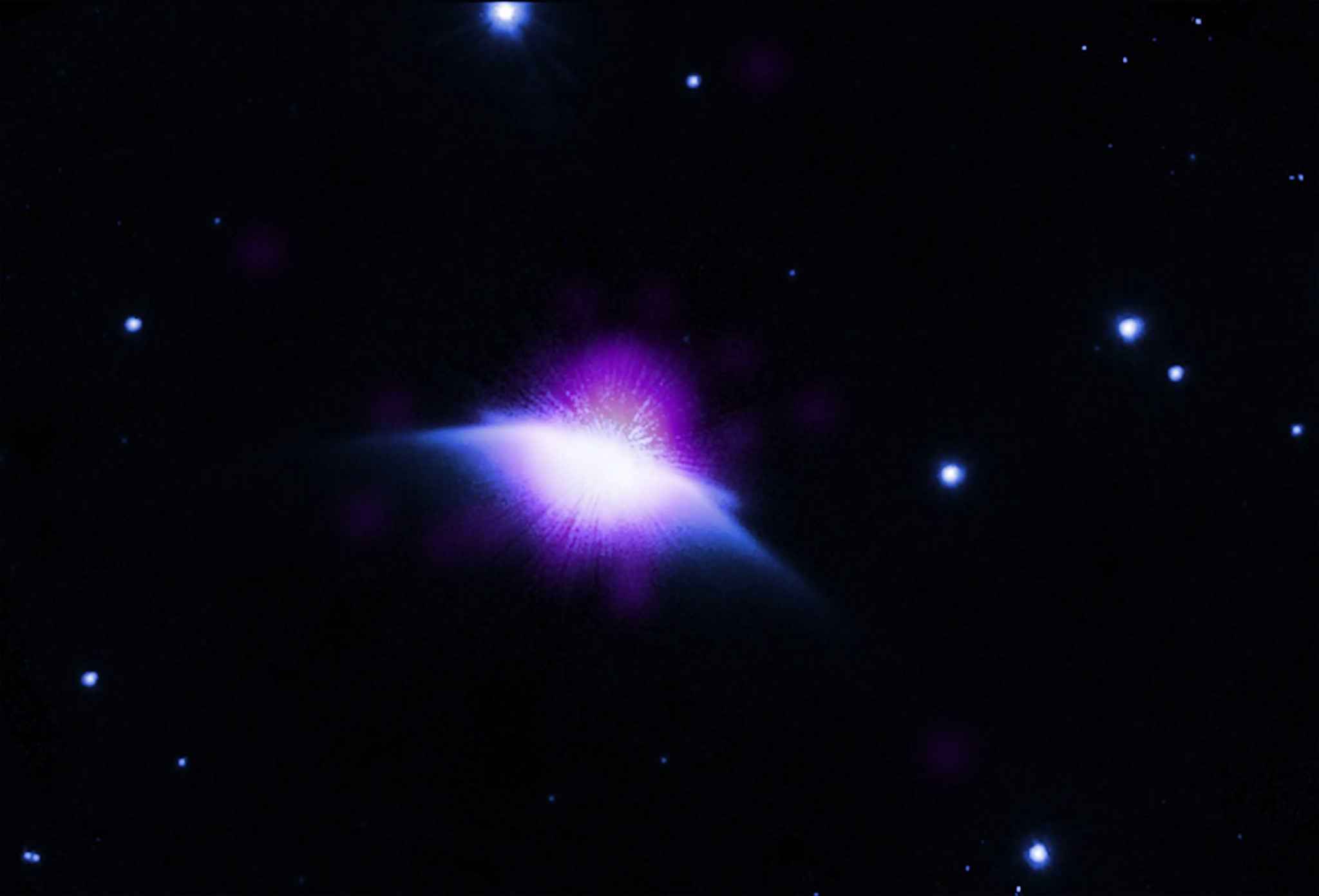
For the first time, a young, Sun-like star has been caught red-handed blowing bubbles in the galaxy, by astronomers using NASA’s Chandra X-ray Observatory. The bubble – called an “astrosphere” – completely surrounds the juvenile star in this image released on Feb. 23, 2026. Winds from the star’s surface are blowing up the bubble and […]
“TIC 120362137 is currently the most compact known 3+1-type quadruple star system.”