Five malicious npm packages impersonating popular crypto libraries are stealing wallet keys from Solana and Ethereum developers and exfiltrating them directly to a hardcoded Telegram bot. Each package typosquats or wraps a legitimate crypto library and funnels stolen private keys to the same Telegram bot-based command-and-control (C2) channel. The campaign hits both Solana and Ethereum […]
Security researchers discovered that the popular Python library litellm was compromised on PyPI. With over 95 million monthly downloads, this open-source tool helps developers route requests across various LLM providers through a single API. The threat actor, identified as TeamPCP, injected malicious code into versions 1.82.7 and 1.82.8. This devastating supply chain attack directly follows the group’s […]
HackerOne, a leading vulnerability coordination and bug bounty platform, has officially confirmed a data breach impacting its employees. The security incident did not occur directly on HackerOne’s internal network or infrastructure. Instead, the sensitive data was exposed through a targeted cyberattack on a third-party service provider known as Navia. Employee Data Stolen According to a […]
Google’s passkey ecosystem quietly depends on a powerful cloud-side component that changes where “passwordless trust” actually lives and that shift could open new avenues for account takeover in the real world. Most passkey discussions focus on WebAuthn and FIDO specs, but attackers care about implementations, not standards. In Google’s case, synced passkeys sit on top […]
A sophisticated supply chain attack compromised Aqua Security’s popular open-source Trivy vulnerability scanner. Threat actors successfully distributed malicious code through the project’s GitHub Actions, targeting deployment pipelines to silently exfiltrate sensitive credentials. While Aqua’s commercial products remain completely unaffected, the incident highlights the severe risks of using mutable version tags in deployment automation. The attack […]
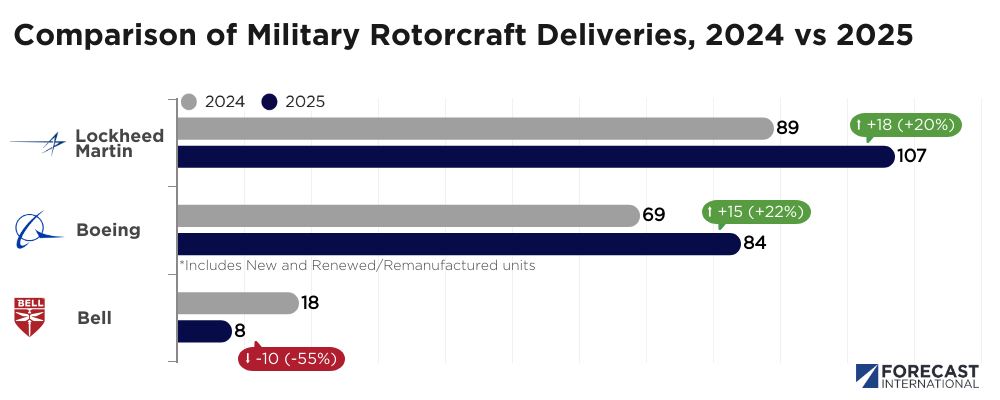
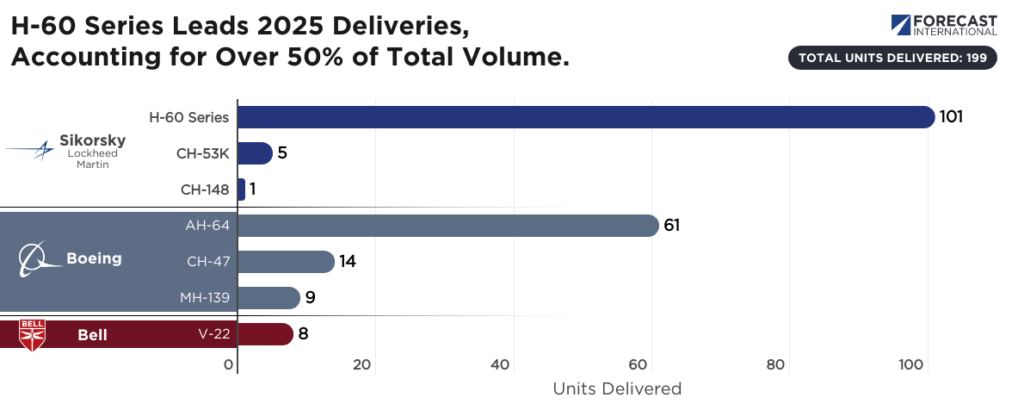
With all the talk of tiltrotors, you'd be forgiven for believing the era of conventional rotorcraft is winding down. But last year, the big three American rotorcraft manufacturers—Bell, Boeing, and Lockheed Martin's Sikorsky—delivered a combined 199 military rotorcraft: 13 percent more than in 2024.
By the Numbers
Sikorsky delivered the most in 2025, anchored by the H-60 line: a total of 101 Black Hawks and Seahawks. Boeing recorded the most growth, increasing annual deliveries by about 22 percent. Bell experienced the only decline among the three companies, delivering ten fewer aircraft in 2025 as AH-1Z exports taper and MV-22 Osprey production for the U.S. Navy and Marine Corps nears completion.
Fall 2025 showed huge contractual wins for Boeing and Sikorsky’s key military helicopter programs. Building on a long-developing agreement, Boeing announced in November that it will build 96 AH-64E Apache attack helicopters for Poland. The deal, valued at $4.7 billion, will make Poland the 19th operator of Apaches—and give it the largest fleet outside of the U.S.
Boeing also secured over $1.6 billion in contracts for its heavy-lift Chinook series late last year. Included in those awards are funding to accelerate U.S. Army fielding of the CH-47 Block II, agreements for the MH-47G for U.S. Special Operations Command, and $876.4 million to produce up to 60 CH-47F Block II helicopters for Germany.
Meanwhile, Sikorsky inked a historic $10.9 billion contract with the U.S. Navy, confirming the Marine Corps’ long-term commitment to the CH-53K. The five-year framework secures five production lots for up to 99 helicopters.
Defense One sister brand Forecast International projects Boeing to build more units from 2026 through 2030, but our estimates show that Sikorsky will build a larger share, about 40 percent, of the total market production value. This prediction is primarily due to the high unit cost of the powerful triple-engine King Stallion.
Tiltrotor Transition
Bell is producing fewer aircraft for the moment, as it prepares to introduce the MV-75 tiltrotor for the U.S. Army Future Long Range Assault Aircraft (FLRAA) program. Assembly work is now underway on the first test aircraft. Bell and the U.S. Army are prioritizing the rapid fielding of the MV-75, with initial production expected in the next one to two years.
Bell’s market position will rise during the mid-2030s as it approaches full-rate manufacturing of the MV-75. Cumulatively, the program could ultimately approach $70 billion. While Boeing and Sikorsky’s helicopter portfolios remain rooted in modernized legacy designs, the MV-75 represents the first clean-sheet U.S. rotorcraft since the joint Bell-Boeing V-22 Osprey entered service nearly 20 years ago.
As the military rotorcraft market moves from today's aircraft to tomorrow's in the next decade, the overall forecast remains robust. Bell, Boeing, and Sikorsky will produce nearly 600 units during the next three years. Meanwhile, rotorcraft demand remains strong in the broader market. European-based Airbus Helicopters delivered 31 more units in 2025 than the previous year across its civil and military product range. The company also reported 544 gross orders in 2025, up from 455 during 2024.
Hybrid Horizon
Naturally, the proliferation of uncrewed systems and drone warfare has raised questions about the viability of manned military rotorcraft. Nonetheless, current market signals project stability and reinforce the utility of these aircraft in contemporary environments. If anything, these forces are driving traditional prime contractors to integrate emerging technologies with their existing platforms while developing next-generation initiatives.
Hedging on the momentum of the U.S. Air Force Collaborative Combat Aircraft (CCA) program, Boeing debuted a similar drone wingman concept last October for accompanying U.S. Army rotorcraft. That same month, Sikorsky unveiled a tablet-controlled UH-60L helicopter, the U-Hawk, which features the company’s MATRIX autonomy suite. More recently, Sikorsky announced a joint project with the Robinson Helicopter Company–a world leader in civil rotorcraft–to integrate MATRIX with the R66 TURBINETRUCK, an autonomous helicopter built on the R66 airframe.
For its part, Bell has been working on uncrewed rotorcraft capabilities for years, most notably under a joint Defense Advanced Research Projects Agency (DARPA) and SOCOM program. Earlier this month, Bell announced that its Speed and Runway Independent Technologies (SPRINT) design entry received the designation X-76, clearing the way to build a high-speed demonstrator. That prototype will likely feature Bell’s revolutionary Stop/Fold rotor system to meet SPRINT requirements for a 400-plus knot aircraft that can operate from austere environments.
Proven Legacy
Uncrewed technologies aside, rotorcraft are demonstrating renewed mission versatility. Israeli and Emirati AH-64 Apache attack helicopters have reportedly downed Iranian Shahed drones in recent combat operations. Likewise, the U.S. Army is testing Apaches for Counter-UAS applications using the underslung 30mm cannon and guided munitions via Advanced Precision Kill Weapon System (APKWS) kits from the stub-wing pylons.
The integration of launched effects and standoff weapons, paired with doctrinal adaptation, is significantly enhancing rotorcraft survivability. High-speed tiltrotor design and uncrewed systems may define the future, yet conventional attack and utility helicopters remain vital, evidenced by market data and operational necessity.
Three weeks into the U.S. war with Iran, it seems increasingly evident that President Donald Trump and his administration miscalculated how Iran would respond to attacks.
The administration’s inconsistent rationale for waging war was laid bare on March 18, 2026, when Tulsi Gabbard, the director of national intelligence, testified before the Senate Intelligence Committee and declined to say whether her agency had made an estimate of if and when Iran would threaten the U.S. mainland.
“It is not the intelligence community’s responsibility to determine what is and is not an imminent threat,” Gabbard said.
The statement was especially odd given that the briefing’s subject was the U.S. intelligence community’s latest global threat assessment. It’s clear to me that neither Gabbard nor other members of the intelligence community were part of Trump’s decision-making about going to war.
Besides serving as chair of the National Intelligence Council in the Barack Obama administration, I was a staff member of the National Security Council in the Jimmy Carter administration. I know that this apparent lack of a coordinated policy on Iran is a far cry from the war preparation and planning done during previous presidential administrations.
National Security Council
Typically, the National Security Council, which consists of the Cabinet secretaries of the national security agencies, does its work through its committees, including the Deputies Committee, which is made up of the top deputies in those departments. The Deputies Committee reviews plans and assesses options, usually presenting a recommendation to the principals, including the president.
In that sense, the National Security Council is seen within an administration as the honest broker, especially in balancing the roles of the two main foreign affairs departments: the State Department and the Defense Department.
To be sure, different administrations have used the National Security Council in different ways.
President Dwight Eisenhower created the modern National Security Council. His was an elaborate structure, with groups for both assessing options and overseeing implementation. It reflected his wartime experience, with careful staffing from a general staff whose responsibilities ranged from operations and logistics to intelligence and plans.
Other administrations have favored less formal arrangements. John F. Kennedy, for instance, kept discussions with the National Security Council secret during the 1962 Cuban missile crisis. But all the National Security Council stakeholders were represented, and Kennedy reached out to consult outside expertise on the Soviet Union.
President Barack Obama and Vice President Joe Biden walk away from the lectern after Obama announced a nuclear deal with Iran on July 14, 2015. AP Photo/Andrew Harnik, Pool
Lyndon Johnson made Tuesday lunches his forum for debating decisions about U.S. involvement in Vietnam. Beginning with just his secretaries of state and defense, the lunches became a National Security Council meeting but in less formal circumstances. The CIA director, the chair of the Joint Chiefs of Staff and the press secretary were later added to the group.
In the Obama administration, the National Intelligence Council I chaired supplied the intelligence support to the Deputies Committee. We provided a steady stream of intelligence assessments across various subjects. Those included pro-democracy protests during the Arab Spring in the 2010s to Russia’s annexation of Crimea in 2014 and the 2015 Iran nuclear deal.
The intelligence assessments provided the information – about where wars stood and what may come next – used for discussion among the deputies. They were discussions informed by experts on the Deputies Committee and from staff on the National Security Council who specialized in the region or military affairs.
This was nowhere better illustrated than in negotiating the Obama administration’s nuclear agreement with Iran. The deal required bringing together experts on Iran and regional dynamics in the Middle East with experts on nuclear fuel cycles and the making of nuclear weapons.
Hardly seen
The Trump administration cut the National Security Council staff in half in May 2025, to around 150. The plan was to streamline and restructure national intelligence under Secretary of State Marco Rubio.
Since White Houses always want to pretend they are cheaper than they are, most staff with the National Security Council are seconded – or loaned for free – from one of the agencies. The process saves the White House money. But it also provides it with invaluable in-house expertise and exposes those seconded officials to presidential policymaking.
A friend and colleague who served as under secretary of defense quipped that every time he saw a State Department counterpart coming to a Deputies Committee meeting, he knew what was coming in substance: a request for a military solution to a geopolitical problem.
His stock answer: “Yes, we can do that, but it’ll require 100,000 soldiers and cost US$10 billion.” That answer was his quip, but the Deputies Committee provided a forum for arguing about the merits of the case.
The Trump administration in January 2025 outlined the National Security Council structure in familiar terms. But the Joint Chiefs of Staff chairman and director of national intelligence, both a regular presence in debates in previous administrations, were made situational rather than regular members. They would attend as needed, not automatically.
This photo provided by the White House shows President Donald Trump talking with White House chief of staff Susie Wiles as Secretary of State Marco Rubio listens at Mar-a-Lago during Operation Epic Fury on Feb. 28, 2026. Daniel Torok/The White House via AP
But the National Security Council has hardly been seen since, unlike Trump’s Cabinet, which gathers occasionally at meetings that often begin with Cabinet members lavishing praise on the president.
Brian Kilmeade of Fox News Radio asked Trump on March 13, 2026, about that inner circle.
“In your Cabinet with the vice president, secretary of state, what is it like, what are the dynamics when you have a big decision like Iran or Venezuela?” Kilmeade asked. “Are people speaking up and speaking their minds?”
Trump’s answer spoke volumes.
“They do,” the president said. “I let them speak their mind, and they do. And we have some differences, but they, they never end up being much. I convince them all to, let’s do it my way.”
Perhaps this casual approach to national security from the Trump administration should not surprise Americans after “Signalgate” – when administration officials in 2025 used the messaging app Signal rather than secure government modes to discuss U.S. military strikes on Yemen and inadvertently included a journalist in the communications.
But when lives are at stake, not to mention Americans’ pocketbooks and the global economy, I think the nation deserves better. Conducting a war requires a hard-headed process for assessing progress and evaluating next steps. In other administrations, the National Security Council would have provided that.
The new director of Cyber Command and the National Security Agency used his first all-hands meeting to urge his workforces to share more intelligence with U.S. allies and partners, according to two people familiar with the matter.
Gen. Josh Rudd told his personnel to work with other allied countries “until it hurts,” one of the people said.
Rudd also said that while the Trump administration has emphasized southern-border security, the NSA still should keep a watchful eye on foreign adversaries such as Russia and China, the second person said.
Both people spoke on the condition of anonymity because they were not authorized to discuss the internal meeting. Rudd was confirmed to lead both organizations earlier this month.
Nextgov/FCW has asked NSA and Cyber Command for comment.
The mission priorities described by Rudd might reassure allies and partners that routinely exchange electronic intelligence with the United States, after months of unease over how White House policies have reshaped intelligence-sharing relationships.
Rudd used the term “YESFORN” — a play on the “NOFORN” classification — to emphasize expanded intelligence sharing with allies, one of the people said.
Both people also said Rudd wants to emphasize a culture of speed, integration and innovation, signaling a push for near real-time signal collection and analysis, tighter informating-sharing across organizations and faster adoption of emerging technologies to track threats.
Rudd comes from a less traditional background than past military leaders who have helmed the two organizations. Up until his confirmation earlier this month, Rudd served as the number two at U.S. Indo-Pacific Command, and he has spent his career largely in special operations and joint command roles. But some former officials and China analysts view Rudd’s Indo-Pacific background as relevant to U.S. cyber operations involving Beijing.
In his nomination hearings, Rudd told senators that his experience consuming and acting on cyber intelligence qualifies him to serve in the position.
In the new role, he will have to contend with declining morale inside NSA, as well as significant workforce cuts that were influenced by Trump 2.0 efforts to shed government bloat and spending waste.
Until Rudd’s confirmation, NSA and Cyber Command have been without a permanent leader since far-right activist Laura Loomer pushed for the firing of the post’s previous occupant, Gen. Timothy Haugh, last April.
HUNTSVILLE, Ala.—Despite recent rumblings that the Army might be looking to change up its latest attempt at replacing the Bradley fighting vehicle, the service is still looking to unveil its choice for the XM-30 early next year.
Two competing vendors will deliver prototypes to Transformation-in-Contact brigades in July, allowing soldiers to give feedback on how the vehicle drives and the kinds of systems that will make it most effective in combat, the Army’s assistant secretary for acquisitions, logistics and technology told reporters Tuesday at the AUSA Global Force Symposium.
“I think the summer will be interesting to see how the prototypes roll out and how well they work,” Brett Ingraham said when asked whether its prospective 2027 Detroit auto show debut will feature one winner, or whether both the Rheinmetall and General Dynamics versions will share the stage.
The mechanized infantry combat vehicle would be the Army’s sixth attempt at replacing the Bradley, a mountain the service has been trying to climb since the 1980s. It could take about a year to get them into production after this summer’s testing, Ingraham added.
“So absolutely, we'll be on the floor next January,” he said. “Absolutely, because it could be on the floor in June.”
[[Related Posts]]
It would also represent a big win for the Army Transformation Initiative, a laundry list of new technology, legacy divestments, and organizational changes Defense Secretary Pete Hegseth issued to the service nearly a year ago.
“We're very optimistic about the gains that we were able to make from divesting of legacy systems, and the ability that we had to reinvest those in two areas, readiness and modernization, so all of the funds recapitalized,” said Army Undersecretary Mike Obadal.
That has included canceling the M-10 Booker light tank, reorganizing combat aviation brigades to phase out the AH-64D Apache helicopter, and setting up an online marketplace for small unmanned aerial systems, to speed up the fielding of drones to every division and beyond.
“This new digital storefront that allows you [to get] this trusted, cutting-edge technology to our soldiers and allies faster,” Ingraham said. “This is 30 systems, roughly, in there, growing every day. We've got basic ordering agreements lined up with the companies in there.”
That friction with Congress is likely to continue as the Army looks to make more changes in line with the transformation initiative.
“We are continuously going through our entire top line budget to determine where, can we make efficiencies where systems that have become obsolete or have come to the point where sustaining them is not economically viable? And that requires continuous, consistent communications with Congress,” Obadal said.