• New API capabilities and AI-powered Threat Encyclopedia eliminate manual audit preparation, providing real-time compliance evidence and instant threat intelligence
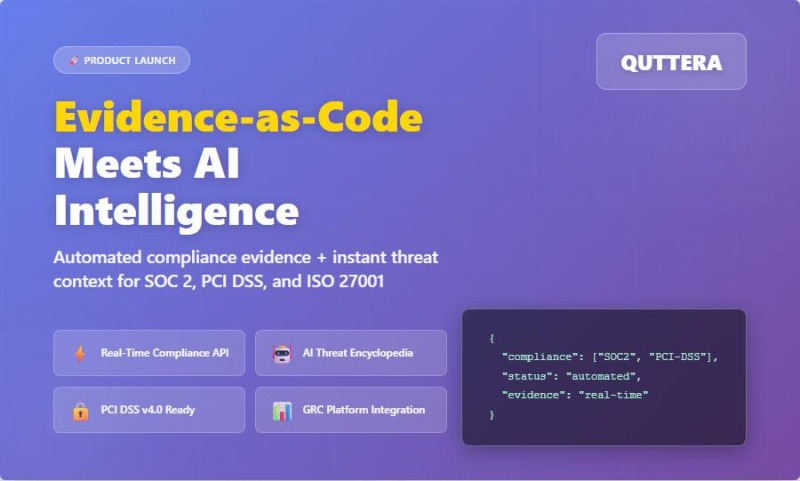
    Quttera today announced major enhancements to its Web Malware Scanner API that transform static security scanning into automated compliance evidence. The update introduces real-time evidence streaming and compliance mapping, directly addressing the manual burden of audit preparation that costs organizations 30-40 hours per audit cycle.

    The announcement includes two integrated capabilities: API-driven compliance automation that feeds structured security evidence into GRC platforms (https://quttera.com/quttera-web-malware-scanner-api), and the Quttera Threat Encyclopedia (https://threats.quttera.com/), an AI-powered resource providing instant context for detected threats.

    Automating the Manual Evidence Chase

    Organizations preparing for SOC 2, ISO 27001, and PCI DSS v4.0 audits traditionally spend dozens of hours manually collecting security evidence—exporting reports, capturing screenshots, and mapping findings to compliance controls. This approach creates outdated evidence, doesn’t scale across frameworks, and fails to prove continuous monitoring.

    “Security teams are exhausted by the manual ‘evidence chase’ required before every audit,” said Michael Novofastovsky, CTO of Quttera. “We’re transforming malware detection into ‘Evidence-as-Code’—structured, real-time security data that flows automatically into compliance workflows. Whether organizations use Drata, Vanta, or custom GRC systems, our API provides continuous proof without human intervention.”

    Quttera’s API converts threat detection into structured JSON with embedded compliance metadata, mapping findings to controls across SOC 2 (CC6.1, CC7.2), PCI DSS v4.0 (Requirements 6.4.3, 11.6.1), ISO 27001, and GDPR simultaneously.

    Addressing PCI DSS v4.0’s New Requirements

    The update specifically targets PCI DSS v4.0 requirements mandatory since March 2025, particularly Requirements 6.4.3 (script authorization on payment pages) and 11.6.1 (file integrity monitoring). These requirements demand continuous automated detection—capabilities manual processes cannot provide at scale.

    “PCI DSS v4.0 requires real-time detection of unauthorized changes to payment scripts,” Novofastovsky explained. “Our API provides timestamped evidence that monitoring is active 24/7, changes are detected automatically, and controls are continuously validated.”

    AI-Powered Threat Intelligence

    The Threat Encyclopedia addresses the context gap security teams face when responding to detections. Integrated directly into scan reports, it provides:

    • Technical breakdown of malware behavior
    • Business impact and risk classification
    • Step-by-step remediation guidance
    • Connections to known attack campaigns

    “We’re automating both sides of the problem,” said Novofastovsky. “The API handles compliance proof. The Threat Encyclopedia handles operational response. Together, they eliminate manual evidence collection and research overhead.”

    The Encyclopedia currently documents 80+ web malware categories, with AI-assisted expansion based on emerging threats.

    Key Capabilities

    • Automated Control Mapping: Detections tagged for multiple compliance frameworks simultaneously
    • Real-Time Evidence Streaming: Continuous JSON feeds replace static PDF reports
    • Behavioral Detection: Heuristic scanning identifies zero-day and polymorphic threats
    • Integration Flexibility: Works with existing GRC platforms via standard REST API

    Availability

    Enhanced capabilities are available immediately to all Quttera API subscribers.

    About Quttera

    Quttera provides automated website security and malware detection solutions, delivering compliance-ready evidence for organizations across financial services, healthcare, e-commerce, and technology sectors. Its comprehensive suite includes advanced heuristic scanning, blacklist monitoring, and remediation services, helping businesses worldwide protect their digital assets and reputation.

    For more information, users can visit https://quttera.com

    Contact

    CTO
    Michael Novofastovsky
    Quttera
    michael@quttera.com

    The post Quttera Launches “Evidence-as-Code” API to Automate Security Compliance for SOC 2 and PCI DSS v4.0V appeared first on Cyber Security News.

    ¶¶¶¶¶

    ¶¶¶¶¶

    ¶¶¶¶¶

    ¶¶¶¶¶

    ¶¶¶¶¶

  • The software supply chain is under siege from “Shai Hulud v2,” a sophisticated malware campaign that has compromised 834 packages across the npm and Maven ecosystems.

    This new wave specifically targets GitHub Actions workflows, exploiting pull_request_target triggers to inject malicious code into widely used libraries.

    The attack has impacted major projects like PostHog, Zapier, and AsyncAPI, leveraging compromised automation tokens to infect downstream dependencies systematically.

    The infection process relies on a stealthy two-stage loader initiated by a pre-install script named setupbun.js.

    This script installs the Bun runtime to execute an obfuscated payload, bunenvironment.js, while suppressing standard output to avoid detection during build logs.

    By pivoting through compromised CI pipelines, the malware gains privileged access to repository secrets, enabling it to modify source code, increment patch versions, and republish infected packages to public registries.

    Socket.dev security analysts identified the malware’s unique persistence mechanism, noting its use of a beacon phrase, “Sha1-Hulud The Second Coming,” effectively searching GitHub to re-trigger infections.

    This ensures that even if individual repositories are cleaned, the attackers can locate and re-compromise vulnerable endpoints.

    Campaign’s impact

    The campaign’s impact is extensive, exposing sensitive credentials from tens of thousands of repositories and marking a dangerous evolution in automated supply chain attacks.

    Once entrenched in a CI environment, the malware executes a comprehensive credential harvesting routine. It captures all available environment variables, specifically targeting GITHUB_TOKEN, NPM_TOKEN, and AWS_ACCESS_KEY_ID, while simultaneously deploying a TruffleHog binary to scan the local filesystem for embedded secrets.

    Sha1-Hulud - The Second Coming (Source - Socket.dev)
    Sha1-Hulud – The Second Coming (Source – Socket.dev)

    Unlike typical scrapers, this payload aggressively enumerates cloud infrastructure, cycling through every region in AWS, Google Cloud, and Azure to extract secrets from managed vaults.

    All stolen data is obscured using three layers of Base64 encoding before being exfiltrated to a randomly generated GitHub repository created within the victim’s account.

    Furthermore, the malware attempts privilege escalation on Linux runners by manipulating sudoers or executing Docker run –privileged commands to gain root access.

    If no valid credentials are found to propagate the worm, the malware executes a destructive wiper function that deletes the files.

    Follow us on Google NewsLinkedIn, and X to Get More Instant UpdatesSet CSN as a Preferred Source in Google.

    The post Shai Hulud v2 Exploits GitHub Actions Workflows as Attack Vector to Steal Secrets appeared first on Cyber Security News.

    ¶¶¶¶¶

    ¶¶¶¶¶

    ¶¶¶¶¶

    ¶¶¶¶¶

    ¶¶¶¶¶

  • Microsoft has announced plans to improve the security of Entra ID authentication by blocking unauthorized script injection attacks starting a year from now. The update to its Content Security Policy (CSP) aims to enhance the Entra ID sign-in experience at “login.microsoftonline[.]com” by only letting scripts from trusted Microsoft domains run. “This update strengthens security and adds an extra

    ¶¶¶¶¶

    ¶¶¶¶¶

    ¶¶¶¶¶

    ¶¶¶¶¶

    ¶¶¶¶¶

  • The “Korean Leaks” campaign has emerged as one of the most sophisticated supply chain attacks targeting South Korea’s financial sector in recent memory.

    This operation combined the capabilities of the Qilin Ransomware-as-a-Service (RaaS) group with potential involvement from North Korean state-affiliated actors known as Moonstone Sleet.

    The attackers leveraged a compromised Managed Service Provider (MSP) as their initial access vector, enabling them to breach multiple organizations through a single point of entry.

    In September 2025, South Korea suddenly became the second most-targeted country for ransomware attacks, with 25 victims claimed in a single month.

    This unusual spike was attributed exclusively to the Qilin ransomware group, which focused almost entirely on financial services firms, specifically asset management companies.

    Of the 33 total victims, 28 are currently public, with documented cases confirming the theft of over 1 million files and 2 TB of data.

    Monthly count of ransomware victims in South Korea (September 2024 – September 2025) (Source - Bitdefender)
    Monthly count of ransomware victims in South Korea (September 2024 – September 2025) (Source – Bitdefender)

    Bitdefender security researchers identified that Qilin operates like a gig economy, where main operators provide branding, software, and infrastructure while taking 15% to 20% of profits.

    The actual hacking is executed by affiliates who earn the majority of the money. What makes this campaign particularly concerning is the early 2025 partnership between Qilin and Moonstone Sleet, a hacking group tied directly to North Korea, blurring the lines between cybercrime and state-sponsored espionage.

    The attackers rolled out their campaign in three distinct publication waves. Wave 1 released 10 victims on September 14, 2025, framing the attacks as a public-service effort to expose systemic corruption.

    Wave 2 escalated threats against the entire Korean stock market, while Wave 3 concluded with nine additional victims before returning to standard extortion messaging.

    MSP Compromise as the Attack Vector

    The root cause analysis revealed that the tight clustering of victims within a single financial niche pointed to a shared vulnerability connecting all targets.

    Initial Qilin DLS listing for a Korean target that contains a direct North Korean reference (Source - Bitdefender)
    Initial Qilin DLS listing for a Korean target that contains a direct North Korean reference (Source – Bitdefender)

    Press reporting on September 23, 2025, confirmed that more than 20 asset management firms suffered breaches after their servers were hacked through a common domestic IT service provider.

    This MSP compromise granted attackers simultaneous access to multiple client networks, explaining the speed and precision of the attack waves.

    Defense recommendations include implementing multi-factor authentication, network segmentation, and adopting EDR/XDR/MDR solutions to minimize adversary dwell time.

    Follow us on Google NewsLinkedIn, and X to Get More Instant UpdatesSet CSN as a Preferred Source in Google.

    The post Qilin RaaS Exposed 1 Million Files and 2 TB of Data Linked to Korean MSP Breach appeared first on Cyber Security News.

    ¶¶¶¶¶

    ¶¶¶¶¶

    ¶¶¶¶¶

    ¶¶¶¶¶

    ¶¶¶¶¶

  • GitLab’s Vulnerability Research team has uncovered a large-scale supply chain attack spreading a destructive malware variant through the npm ecosystem.

    The malware, an evolved version of “Shai-Hulud,” contains a dangerous feature that threatens to destroy user data if attackers lose control of their infrastructure. The malware spreads through infected npm packages using a multi-stage process.

    When developers install a compromised package, a script automatically downloads what appears to be a legitimate version of the Bun JavaScript runtime.

    Affected npm Packages

    However, this is a disguise for the malware’s actual payload. This heavily obfuscated 10MB file executes on the victim’s system.

    Once running, the malware aggressively harvests credentials from multiple sources, including GitHub tokens, npm authentication keys, and accounts for AWS, Google Cloud, and Microsoft Azure.

    It even downloads Trufflehog, a legitimate security tool, to scan the entire home directory for hidden API keys and passwords stored in configuration files.

    Attack Work Flows
    Attack Work Flows

    Using stolen npm tokens, the malware automatically infects all other packages maintained by the victim.

    It modifies the package.json files to include malicious scripts, increments version numbers, and republishes everything to npm.

    This worm-like behavior means the attack spreads exponentially across the ecosystem. The stolen credentials are exfiltrated to attacker-controlled GitHub repositories marked with “Sha1-Hulud: The Second Coming.”

    These repositories create a resilient botnet-like network in which compromised systems share access tokens.

    Most critically, the malware includes a destructive payload designed to protect the attack’s infrastructure. If an infected system simultaneously loses access to both GitHub and npm, it triggers immediate data destruction.

    On Windows systems, the malware attempts to delete all user files and overwrite disk sectors. On Linux and Mac systems, it uses advanced wiping techniques to make file recovery impossible.

    This creates a dangerous scenario: if GitHub removes malicious repositories or npm revokes compromised tokens, thousands of infected systems could simultaneously destroy user data across the internet.

    GitLab recommends enabling Dependency Scanning in your projects to detect compromised packages before they reach production automatically.

    Security teams should also monitor for suspicious npm preinstall scripts and unusual version increments in their dependencies.

    Follow us on Google News, LinkedIn, and X for daily cybersecurity updates. Contact us to feature your stories.

    The post Dead Man’s Switch – Widespread npm Supply Chain Attack Driving Malware Attacks appeared first on Cyber Security News.

    ¶¶¶¶¶

    ¶¶¶¶¶

    ¶¶¶¶¶

    ¶¶¶¶¶

    ¶¶¶¶¶

  • An urgent security update for its DGX Spark AI workstation after discovering 14 vulnerabilities in the system’s firmware that could allow attackers to execute malicious code and launch denial-of-service attacks.

    The most severe flaw has a CVSS score of 9.3 and affects all DGX Spark devices running versions before the new OTA0 update.

    The vulnerabilities reside in multiple firmware components of the DGX Spark GB10, including SROOT, OSROOT, and hardware resource controls.

    NVIDIA’s Offensive Security Research team identified these flaws, which expose the AI workstation to serious security risks.

    Attackers with local access can exploit these weaknesses to bypass security protections, modify hardware controls, and gain unauthorized access to protected areas of the system-on-chip.

    The critical vulnerability, tracked as CVE-2025-33187, allows attackers with privileged access to breach SoC-protected areas.

    CVE IDBase ScoreCWEPotential Impacts
    CVE-2025-331879.3CWE-269Code execution, information disclosure, data tampering, denial of service, escalation of privileges
    CVE-2025-331888.0CWE-269Information disclosure, data tampering, denial of service
    CVE-2025-331897.8CWE-787Code execution, data tampering, denial of service, information disclosure, escalation of privileges
    CVE-2025-331906.7CWE-787Code execution, data tampering, denial of service, escalation of privileges
    CVE-2025-331915.7CWE-20Denial of service
    CVE-2025-331925.7CWE-690Code execution, denial of service, information disclosure
    CVE-2025-331935.7CWE-354Code execution, denial of service, information disclosure
    CVE-2025-331945.7CWE-180Information disclosure, denial of service
    CVE-2025-331954.4CWE-119Data tampering, denial of service, escalation of privileges
    CVE-2025-331964.4CWE-226Information disclosure
    CVE-2025-331974.3CWE-476Code execution, denial of service
    CVE-2025-331983.3CWE-226Information disclosure
    CVE-2025-331993.2CWE-670Data tampering
    CVE-2025-332002.3CWE-226Information disclosure

    Potentially leading to code execution, data theft, system manipulation, denial-of-service attacks, or privilege escalation. This flaw requires immediate attention due to its critical severity rating and comprehensive impact on system integrity.

    All NVIDIA DGX Spark systems running versions before OTA0 are vulnerable. The security update addresses all 14 CVEs simultaneously.

    NVIDIA urges customers to download and install the latest DGX OS version immediately from the official NVIDIA DGX website.

    Users can also visit the NVIDIA Product Security page to subscribe to security bulletins and report potential security issues. The vulnerabilities primarily require local access to exploit, though some can be triggered without privileges.

    Organizations using DGX Spark workstations for AI development and machine learning workloads should prioritize this update to prevent potential compromise of sensitive AI models and training data.

    Follow us on Google News, LinkedIn, and X for daily cybersecurity updates. Contact us to feature your stories.

    The post NVIDIA DGX Spark Vulnerabilities Let Attackers Execute Malicious Code and DoS Attacks appeared first on Cyber Security News.

    ¶¶¶¶¶

    ¶¶¶¶¶

    ¶¶¶¶¶

    ¶¶¶¶¶

    ¶¶¶¶¶

  • KawaiiGPT emerges as an accessible, open-source tool that mimics the controversial WormGPT, providing unrestricted AI assistance via jailbroken large language models. Hosted on GitHub with over 188 stars and 52 forks, it requires no API keys and installs quickly on Linux or Termux environments.​

    Users can deploy KawaiiGPT in minutes by updating packages, installing Python and Git, cloning the repository, and running simple install and launch scripts.

    Linux distributions use apt-get commands, while Termux users use pkg equivalents, highlighting its lightweight design for pentesting or casual experimentation. The developer encourages starring the project for support and directs queries to a Telegram forum.​

    At its core, KawaiiGPT employs a reverse-engineered API wrapper derived from pollinations agents, routing queries to backend servers hosting models like DeepSeek, Gemini, and Kimi-K2.

    These integrations enable prompt-injection responses that bypass safety guardrails, producing uncensored outputs labeled as “fun” rather than malicious. Unlike fine-tuned models, it relies on prepared LLMs with embedded jailbreaks accessible via a help menu.​

    Security researchers highlight KawaiiGPT’s process in generating phishing emails, ransomware notes, lateral movement scripts using Paramiko, and data exfiltration tools.

    Its casual “kawaii” persona featuring playful greetings masks potent outputs for social engineering and elemental attacks, lowering barriers for novice threat actors. First noted in July 2025 and now at version 2.5, it contrasts paid tools like WormGPT 4 by offering free, community-driven enhancements.​

    The codebase’s obfuscation sparks debate, with the creator explaining that it prevents unauthorized repackaging and resale while denying the presence of malware, RATs, or spyware. Warnings urge verifying sources to avoid fakes, and the MIT-licensed project prohibits modifications for profit.

    A 180-500 member Telegram community shares tips, fueling its evolution amid Palo Alto Networks’ alerts on rising cybercrime automation.​

    Organizations face heightened threats from such tools, demanding advanced email filters, MFA, EDR, and training to counter AI-aided phishing and scripts. While positioned for ethical pentesting, KawaiiGPT’s free nature amplifies risks in an era of dual-use AI.​

    FeatureKawaiiGPTWormGPT 4
    CostFree (Open Source)Paid Subscription (~$50/mo)
    Underlying TechJailbroken Commercial Models (Gemini, DeepSeek)Custom/Fine-Tuned Model
    Access MethodPython Script / GitHubDark Web / Private Forum
    Primary RiskLowers entry barrier for novicesAdvanced, optimized attack scripts
    GuardrailsBypassed via Prompt InjectionNatively Uncensored

    Follow us on Google News, LinkedIn, and X for daily cybersecurity updates. Contact us to feature your stories.

    The post KawaiiGPT – Free WormGPT Variant Leveraging DeepSeek, Gemini, and Kimi-K2 AI Models appeared first on Cyber Security News.

    ¶¶¶¶¶

    ¶¶¶¶¶

    ¶¶¶¶¶

    ¶¶¶¶¶

    ¶¶¶¶¶

  • A major security threat has emerged targeting software developers worldwide. North Korean state-sponsored threat actors, operating under the “Contagious Interview” campaign, are systematically spreading malicious packages across npm, GitHub, and Vercel infrastructure to deliver OtterCookie malware.

    This sophisticated multi-stage operation demonstrates how threat actors have adapted their tools to target modern JavaScript and Web3 development workflows.

    Since October 10, 2025, researchers have uncovered at least 197 new malicious npm packages designed to trick developers into installing compromised code, with over 31,000 additional downloads recorded during this wave alone.

    The attack chain works through a carefully coordinated supply chain approach. Threat actors create fake developer portfolios on GitHub, publish typosquatted packages on npm that impersonate legitimate libraries, and use Vercel hosting to stage the malware payloads.

    When developers unknowingly install these malicious packages, a postinstall script automatically executes and reaches out to attacker-controlled endpoints to fetch and run the latest OtterCookie variant.

    This seamless integration into standard development workflows makes the attack particularly dangerous, as it bypasses traditional security awareness since developers expect npm packages to execute code during installation.

    Socket.dev security analysts noted and identified that the infrastructure behind this campaign reveals a well-orchestrated operation.

    The researchers traced malicious packages like “tailwind-magic,” which impersonates the legitimate “tailwind-merge” library, to a threat actor-controlled GitHub account named “stardev0914” and a Vercel staging endpoint called “tetrismic.vercel.app.”

    Contagious Interview attack chain (Source - Socket.dev)
    Contagious Interview attack chain (Source – Socket.dev)

    This account contained at least 18 repositories designed to serve as both delivery vehicles and convincing lures, with repositories themed around cryptocurrency projects including fake DEX front-ends and token sites.

    At least five core malicious packages, including “node-tailwind,” “tailwind-node,” and “react-modal-select,” route through this infrastructure.

    The malware architecture itself reflects sophisticated development. OtterCookie operates as a combined infostealer and remote access trojan with cross-platform capabilities spanning Windows, macOS, and Linux.

    Once executed within a Node.js process, the malware performs initial environment checks to detect virtual machines and sandboxes, fingerprints the infected host, and then establishes bidirectional communication with command and control servers.

    This detection-evasion approach ensures the malware only fully activates on legitimate developer machines rather than analyst environments where security researchers typically operate.

    Infection and Persistence Mechanisms

    The infection mechanism demonstrates meticulous engineering. The malicious npm packages use a postinstall script that executes when developers run npm install.

    This script calls the threat actor endpoint at https://tetrismic.vercel.app/api/ipcheck using axios, which returns JavaScript code embedded in a JSON field named “model.”

    Annotated GitHub view of the threat actor-controlled account stardev0914 (Source - Socket.dev)
    Annotated GitHub view of the threat actor-controlled account stardev0914 (Source – Socket.dev)

    The package then extracts this field and executes it with eval inside the victim’s Node.js process, granting the attackers full Node.js privileges and allowing arbitrary code execution.

    The staging server continuously updates its main.js payload, enabling threat actors to rotate malware variants across multiple packages and customize responses per target.

    Once deployed, OtterCookie establishes persistence through multiple mechanisms. On Windows systems, the malware creates scheduled tasks named “NodeUpdate” that run at logon with highest privileges, and adds registry entries under HKCU\Run\NodeHelper.

    The actual payload spawns three asynchronous worker processes using child_process.spawn, each running as a detached Node.js process with stdio redirected to ignore and the windowsHide flag set true.

    These processes then unref themselves, allowing them to continue running in the background after the initial loader exits.

    KXCO-branded DEX front end hosted at knightsbridge-dex[.]vercel[.]app (Source - Socket.dev)
    KXCO-branded DEX front end hosted at knightsbridge-dex[.]vercel[.]app (Source – Socket.dev)

    The malware simultaneously performs system-wide keylogging using the GlobalKeyboardListener module, captures screenshots from all connected monitors every 5 seconds, exfiltrates clipboard contents, and recursively scans the filesystem for files matching patterns like “.env,” “metamask,” “phantom,” and “seed” to harvest cryptocurrency wallet data and credentials.

    The comprehensive data harvesting capabilities extend to browser profiles. The malware specifically targets Chrome and Brave browsers on all three operating systems, accessing stored login credentials by querying the “Login Data” SQLite database found in each browser’s profile directory.

    Additionally, it identifies and extracts data from at least 42 different cryptocurrency wallet browser extensions, including MetaMask, Phantom, Keplr, and dozens of others commonly used by Web3 developers.

    All collected data flows through the command and control infrastructure at IP address 144.172.104.117, which handles both data collection and tasking, allowing threat actors to issue remote commands and maintain persistent interactive shell access.

    Follow us on Google NewsLinkedIn, and X to Get More Instant UpdatesSet CSN as a Preferred Source in Google.

    The post North Korean Hackers Exploiting npm, GitHub, and Vercel to Deliver OtterCookie Malware appeared first on Cyber Security News.

    ¶¶¶¶¶

    ¶¶¶¶¶

    ¶¶¶¶¶

    ¶¶¶¶¶

    ¶¶¶¶¶

  • GitLab has released critical security updates for its Community Edition (CE) and Enterprise Edition (EE) to address multiple high-severity vulnerabilities.

    The patches, rolled out in versions 18.6.1, 18.5.3, and 18.4.5, fix security flaws that could allow attackers to bypass authentication, steal user credentials, or crash servers through Denial-of-Service (DoS) attacks.

    Security experts and GitLab administrators are being urged to upgrade their self-managed installations immediately. GitLab.com has already been patched to protect users.

    Credential Theft and System Crashes

    The most concerning vulnerability in this release is CVE-2024-9183, a high-severity issue labeled as a “race condition” in the CI/CD cache.

    This flaw could allow an authenticated attacker to steal credentials from users with higher privileges.

    By exploiting this timing error, a malicious user could take over administrative accounts or perform unauthorized actions.

    CVE IDSeverityTypeDescription
    CVE-2024-9183HighPrivilege EscalationA race condition in CI/CD cache allowing users to obtain higher-privileged credentials.
    CVE-2025-12571HighDenial of ServiceUnauthenticated users can crash the system via malicious JSON input.
    CVE-2025-12653MediumAuth BypassUnauthenticated users could join arbitrary organizations by altering headers.
    CVE-2025-7449MediumDenial of ServiceAuthenticated users can cause a crash via HTTP response processing.
    CVE-2025-6195MediumImproper Authorization(EE Only) Users could view restricted security reports under certain conditions.
    CVE-2025-13611LowInfo DisclosureLeak of sensitive tokens in the terraform registry logs.

    Another major fix addresses CVE-2025-12571, a dangerous Denial-of-Service flaw.

    This vulnerability allows unauthenticated attackers without a username or password to crash a GitLab instance by sending a malicious JSON request.

    This type of attack could take an organization’s code repositories offline, disrupting development workflows.

    Authentication Bypasses

    The update also resolves CVE-2025-12653, a medium-severity issue that could allow unauthenticated users to bypass security checks and join arbitrary organizations by manipulating network request headers.

    While less severe than the crash flaw, this bypass poses a significant risk to organizational privacy and access control.

    The following table details the security issues resolved in this patch release:

    GitLab strongly recommends that all customers running affected versions upgrade to the latest patch immediately. Upgrade targets: Versions 18.6.1, 18.5.3, or 18.4.5.

    Impact: Single-node instances will experience downtime during the upgrade due to database migrations. Multi-node instances can perform zero-downtime upgrades.

    Failure to update leaves installations exposed to attackers who can now analyze the public patches to reverse-engineer exploits.

    Follow us on Google News, LinkedIn, and X for daily cybersecurity updates. Contact us to feature your stories.

    The post Gitlab Patches Multiple Vulnerabilities that Enable Authentication Bypass and DoS Attacks appeared first on Cyber Security News.

    ¶¶¶¶¶

    ¶¶¶¶¶

    ¶¶¶¶¶

    ¶¶¶¶¶

    ¶¶¶¶¶

  • OpenAI has publicly disclosed a security incident involving a data breach at Mixpanel, a third-party analytics provider previously used by the company for monitoring usage on its API platform. The breach exposed limited but sensitive user information, including names, email addresses, operating system details, and browser metadata. According to OpenAI, the incident originated within Mixpanel’s […]

    The post OpenAI Reveals Mixpanel Data Breach Exposing User Details appeared first on GBHackers Security | #1 Globally Trusted Cyber Security News Platform.

    ¶¶¶¶¶

    ¶¶¶¶¶

    ¶¶¶¶¶

    ¶¶¶¶¶

    ¶¶¶¶¶