Federal cybersecurity agency CISA has disclosed that attackers exploited a remote code execution vulnerability in GeoServer to breach a U.S. federal civilian executive branch agency. The incident response began after endpoint detection alerts sounded at the agency. Over three weeks, cyber intruders used the flaw to gain initial access, move laterally, and establish persistence across […]
A severe Stored Cross-Site Scripting (XSS) vulnerability in the Prompt module of the DNN Platform enables low-privilege attackers to inject and execute arbitrary scripts in the context of privileged users. Published as GHSA-2qxc-mf4x-wr29 by Daniel Valadas yesterday, this vulnerability affects all versions of the DotNetNuke.Core package prior to 10.1.0 and carries a CVSS v3.1 base […]
Libraesva has issued an emergency patch for a significant command injection vulnerability in its Email Security Gateway (ESG) after confirming state-sponsored hackers exploited it.
The flaw, identified as CVE-2025-59689, allowed attackers to execute arbitrary commands by sending a malicious email with a specially crafted compressed attachment. The company responded by deploying an automated fix to customers within 17 hours of discovering the active exploitation.
The vulnerability originates from improper sanitization when the ESG product processes certain compressed archive formats. Attackers could construct a malicious email attachment that, when scanned by the gateway, would bypass security checks and allow the injection of shell commands.
A successful exploit would grant the attacker the ability to execute arbitrary commands on the affected system, albeit as a non-privileged user.
From there, the actor could potentially engage in lateral movement, establish persistence, or attempt to escalate privileges. The flaw impacts all Libraesva ESG versions from 4.5 onwards.
Confirmed State-Sponsored Attack
Libraesva confirmed at least one incident where the vulnerability was actively abused in the wild. The company attributes the attack to a “foreign hostile state entity,” highlighting the sophisticated nature of the threat actor.
According to Libraesva, the targeted nature of the attack, which focused on a single appliance, underscores the precision and strategic intent of the adversary.
This targeted approach suggests the attackers were not conducting a widespread campaign but rather a focused operation against a specific organization.
In response to the exploit, Libraesva took swift action, developing and deploying a patch in just 17 hours. The emergency update was automatically pushed to all cloud-based and on-premise ESG appliances running version 5.x.
The comprehensive patch not only addressed the root sanitization flaw but also included an automated scanner to detect Indicators of Compromise (IoCs) and a self-assessment module to verify the patch’s integrity.
Libraesva has provided the following guidance for its customers:
Cloud Customers: All cloud appliances have been automatically updated, and no further action is required.
On-Premise 5.x Customers: These appliances should have received the automatic update. Administrators are advised to verify that their system is running a patched version.
On-Premise 4.x Customers: Versions below 5.0 are End of Support (EOS) and did not receive the automatic patch. These customers must manually upgrade to a supported 5.x version to protect their systems from this exploited vulnerability.
The fixes are available in versions 5.0.31, 5.1.20, 5.2.31, 5.3.16, 5.4.8, and 5.5.7. Given the active exploitation by a nation-state actor, organizations using Libraesva ESG are urged to ensure their appliances are running a patched version immediately.
A sophisticated cybercrime campaign has emerged that transforms legitimate AWS infrastructure into weaponized attack platforms through an innovative combination of containerization and distributed denial-of-service capabilities.
The ShadowV2 botnet represents a significant evolution in cyber threats, leveraging exposed Docker daemons on Amazon Web Services EC2 instances to establish persistent footholds for large-scale DDoS operations.
This campaign demonstrates an alarming shift toward professional, service-oriented cybercrime infrastructure that mirrors legitimate cloud-native applications in both design and functionality.
The attack begins with threat actors operating from GitHub CodeSpaces, utilizing a Python-based command-and-control framework to scan for and exploit misconfigured Docker installations.
Unlike traditional botnet operations that rely on pre-built malicious containers, ShadowV2 employs a unique multi-stage deployment process that creates custom containerized environments directly on victim machines.
The malware establishes communication with its operators through a RESTful API architecture, implementing sophisticated polling and heartbeat mechanisms that ensure persistent connectivity while evading detection through legitimate-appearing network traffic.
Darktrace analysts identified the malware during routine honeypot monitoring, discovering that the campaign specifically targets AWS EC2 instances running exposed Docker daemons.
The login UI (Source – Darktrace)
The researchers observed the threat actors using advanced attack techniques including HTTP/2 rapid reset attacks, Cloudflare under-attack mode bypasses, and large-scale HTTP flood campaigns.
These capabilities, combined with a fully operational user interface and OpenAPI specification, indicate that ShadowV2 functions as a comprehensive DDoS-as-a-service platform rather than a traditional botnet, offering paying customers the ability to launch sophisticated distributed attacks against targeted infrastructure.
A snippet showing the fasthttp client creation loop (Source – Darktrace)
The malware’s architecture reveals a concerning level of professionalism, with the entire operation designed around a modular, service-oriented approach that includes user authentication, privilege management, and attack limitations based on subscription tiers.
This evolution represents a fundamental shift in cybercrime economics, where malicious infrastructure increasingly resembles legitimate software-as-a-service offerings in terms of user experience, reliability, and feature completeness.
Technical Infection and Deployment Mechanism
The ShadowV2 botnet employs a sophisticated three-stage deployment process that distinguishes it from conventional Docker-based malware campaigns.
Initial compromise occurs through Python scripts hosted on GitHub CodeSpaces, identifiable through distinctive HTTP headers including User-Agent: docker-sdk-python/7.1.0 and X-Meta-Source-Client: github/codespaces.
These indicators reveal the attackers’ use of the Python Docker SDK library, which enables programmatic interaction with Docker daemon APIs to create and manage containerized environments on target systems.
The poll mechanism (Source – Darktrace)
The attack methodology deviates significantly from typical Docker exploitation patterns. Instead of deploying pre-built malicious images from Docker Hub or uploading custom containers, the malware first spawns a generic Ubuntu-based setup container and dynamically installs necessary tools within it.
This container is then committed as a new image and deployed as a live container with malware arguments passed through environmental variables including MASTER_ADDR and VPS_NAME identifiers.
The containerized payload consists of a Go-based ELF binary located at /app/deployment that implements a robust communication protocol with the command-and-control infrastructure.
Upon execution, the malware generates a unique VPS_ID by concatenating the provided VPS_NAME with the current Unix timestamp, ensuring distinct identification for each compromised system.
This identifier facilitates command routing and maintains session continuity even across malware restarts or reinfections.
The binary establishes two persistent communication loops: a heartbeat mechanism that transmits the VPS_ID to hxxps://shadow.aurozacloud[.]xyz/api/vps/heartbeat every second via POST requests, and a command polling system that queries hxxps://shadow.aurozacloud[.]xyz/api/vps/poll/<VPS_ID> every five seconds through GET requests.
This dual-channel approach ensures both operational visibility for attackers and reliable command delivery to compromised infrastructure, while maintaining the appearance of legitimate API traffic that can evade network-based detection mechanisms.
Follow us on Google News, LinkedIn, and X to Get More Instant Updates, Set CSN as a Preferred Source in Google.
Cisco Talos has uncovered a sophisticated, long-running campaign active since 2022 that leverages DLL search order hijacking to deliver a novel PlugX variant with overlapping characteristics of the RainyDay and Turian backdoors. This operation, targeting telecommunications and manufacturing organizations across Central and South Asia, demonstrates a remarkable convergence of malware functionality and shared infrastructure that […]
A sophisticated new malware family dubbed YiBackdoor has emerged in the cybersecurity landscape, posing a significant threat to organizations worldwide.
First observed in June 2025, this malicious software represents a concerning evolution in backdoor technology, featuring advanced capabilities that enable threat actors to execute arbitrary commands, capture screenshots, collect sensitive system information, and deploy additional malicious plugins on compromised hosts.
The malware’s architecture demonstrates significant code overlaps with established threats IcedID and Latrodectus, suggesting potential collaboration between threat actor groups or shared development resources.
Similar to notorious banking trojans like Zloader and Qakbot, IcedID was originally designed for facilitating financial fraud but has since evolved into a primary tool for providing initial access to ransomware operators.
YiBackdoor appears to follow this same trajectory, potentially serving as a gateway for more destructive cyberattacks.
Zscaler analysts identified YiBackdoor through comprehensive threat hunting activities and noted its sophisticated anti-analysis capabilities designed to evade detection by security researchers and automated sandbox environments.
Network dynamic key derivation function for YiBackdoor (Source – Zscaler)
The malware demonstrates advanced virtual environment detection techniques, including hypervisor identification for VMware, Xen, KVM, VirtualBox, Microsoft Hyper-V, and Parallels systems.
The malware’s limited deployment patterns suggest it may currently be in a development or testing phase, according to security researchers.
However, its advanced capabilities and connection to established malware families indicate that broader deployment campaigns could emerge as development progresses.
The threat actor’s use of local IP addresses in configuration files further supports the assessment that YiBackdoor remains in active development.
Code Injection and Persistence Mechanisms
YiBackdoor employs a sophisticated process injection technique that sets it apart from conventional malware families.
The malware utilizes a unique approach to achieve code execution within legitimate system processes, specifically targeting svchost.exe for its injection operations.
During the initialization phase, YiBackdoor performs a critical check to determine whether it is already running within an injected process by examining its current memory address against loaded DLL ranges.
If the malware detects it is not yet injected, it creates a new svchost.exe process and begins the injection sequence.
The malware allocates memory within the target process and copies its malicious code into the newly created memory region.
Comparison of YiBackdoor and IcedID GZIP decryption routines (Source – Zscaler)
The most notable aspect of YiBackdoor’s injection technique involves patching the Windows API function RtlExitUserProcess with custom assembly code.
This patch redirects execution flow to YiBackdoor’s entry point when the function is called, effectively hijacking the process termination sequence.
The following code demonstrates the hypervisor detection mechanism used by the malware:-
Persistence establishment occurs through Windows Registry manipulation, where YiBackdoor copies itself to a randomly named directory and creates registry entries using regsvr32.exe for automatic execution upon system startup.
The malware generates pseudo-random values for registry key names using Microsoft’s Linear Congruential Generator algorithm, making detection through static signatures more challenging for security products.
Follow us on Google News, LinkedIn, and X to Get More Instant Updates, Set CSN as a Preferred Source in Google.
The U.S. Cybersecurity and Infrastructure Security Agency (CISA) has issued a warning about a high-severity zero-day vulnerability in Google Chrome that is being actively exploited in attacks.
The vulnerability, tracked as CVE-2025-10585, has been added to CISA’s Known Exploited Vulnerabilities (KEV) catalog, signaling an urgent need for users and administrators to take action.
Google has confirmed it is aware that an exploit for this flaw exists in the wild and has released security updates to address the threat.
Understanding the V8 Type Confusion Flaw
The vulnerability is a type confusion weakness within Chrome’s V8 JavaScript and WebAssembly engine. A type confusion flaw (CWE-843) occurs when a program attempts to access a resource with an incompatible type, causing it to misinterpret the data.
This can lead to memory corruption, which an attacker can leverage to crash the browser or, more critically, execute arbitrary code on the affected system.
The flaw was discovered and reported by Google’s own Threat Analysis Group (TAG) on September 16, 2025.
While Google has not disclosed technical details about the specific attacks or the threat actors involved, this is a standard practice to prevent wider exploitation before users have a chance to apply the necessary patches.
This marks the sixth Chrome zero-day vulnerability that has been actively exploited in 2025, highlighting a persistent trend of attackers targeting browser vulnerabilities.
In 2025, Google addressed multiple zero-day vulnerabilities in its Chrome web browser that were actively exploited in the wild. These flaws required urgent updates to protect users from potential attacks.
The table below details the Chrome zero-day vulnerabilities that have been discovered and patched throughout the year.
This vulnerability was addressed by Google as a zero-day, but it is unclear if it was actively exploited in malicious attacks.
Insufficient validation of untrusted input in the ANGLE and GPU components allows a remote attacker to perform a sandbox escape.
CISA Directive and Recommended Actions
In response to the active exploitation, CISA has directed Federal Civilian Executive Branch (FCEB) agencies to apply the necessary security updates by October 14, 2025, in accordance with Binding Operational Directive (BOD) 22-01.
While this directive is mandatory for federal agencies, CISA strongly urges all organizations and individual users to prioritize patching their systems to defend against potential attacks.
To mitigate the vulnerability, users should update their Chrome browser to the latest version:
Windows and macOS: 140.0.7339.185/.186
Linux: 140.0.7339.185
Users can initiate the update by navigating to Chrome’s menu, selecting “Help,” and then “About Google Chrome,” which will trigger an automatic check for and installation of the latest version.
Users of other Chromium-based browsers, such as Microsoft Edge, Brave, Opera, and Vivaldi, are also advised to apply security updates as soon as they become available from their respective vendors.
Enabling automatic updates is highly recommended to ensure prompt protection against future threats.
Threat actors are leveraging the legacy Windows error‐reporting utility WerFaultSecure.exe to extract the memory region of the Local Security Authority Subsystem Service (LSASS.EXE) and harvest cached credentials from fully patched Windows 11 24H2 systems.
After gaining initial access to a host, adversaries frequently seek to dump LSASS memory to escalate privileges and move laterally across the network.
Modern Windows severely restricts direct memory access to LSASS by enforcing Protected Process Light (PPL), requiring kernel privilege or a peer PPL process for interaction.
Zero Salarium researchers have now demonstrated how to bypass these defenses by running a vulnerable WerFaultSecure.exe binary compiled for Windows 8.1 under Windows 11, thereby obtaining an unencrypted memory dump of LSASS.
Leveraging WerFaultSecure.exe’s PPL Privilege
WerFaultSecure.exe is part of the Windows Error Reporting (WER) framework and normally executes with the highest PPL label, WinTCB, to collect crash dumps from protected processes.
Its protected status allows it to access LSASS memory under the guise of a crash handler.
In Windows 8.1, a flaw existed whereby WerFaultSecure.exe could be imposed into writing crash dumps without applying its built‐in encryption routines, resulting in unencrypted dump files on disk.
Exploiting WerFaultSecure.exe
By copying the vulnerable WerFaultSecure.exe from Windows 8.1 onto a Windows 11 24H2 machine and launching it with PPL elevation, attackers can trick the tool into capturing LSASS memory and writing a raw dump.
Zero Salarium reports that the exploit sequence involves running WerFaultSecure.exe with undocumented switches discovered through reverse engineering: /h to invoke secure hidden crash mode, /pid [pid] to target the LSASS process, /tid [tid] to specify its main thread, and /file [handle] to designate an unencrypted output handle.
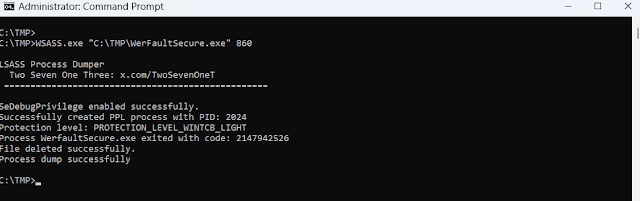
The attacker uses a custom loader named WSASS to spawn WerFaultSecure.exe via the CreateProcessAsPPL API, inheriting handles for the crash dump and event objects.
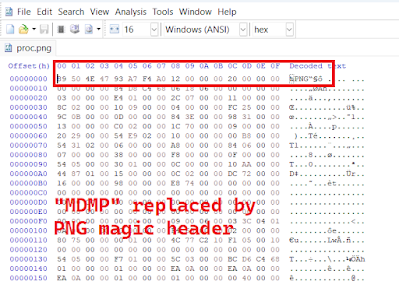
WSASS waits for dump completion, then replaces the first four bytes of the generated file (from the PNG magic header) with the MDMP signature (0x4D,0x44,0x4D,0x50) so it masquerades as a benign image device and evades antivirus checks.
MDMP replaced
Finally, the loader resumes any suspended threads in LSASS by issuing minimal PROCESS_SUSPEND_RESUME rights to restore system stability.
Once the attacker restores the MDMP header, the resulting minidump can be loaded into standard tools, such as pypykatz or Mimikatz, to extract NTLM hashes and plaintext credentials, facilitating further lateral movement.
This technique underscores the importance of monitoring WerFaultSecure.exe binaries outside the System32 directory and validating PPL‐protected process invocations to detect anomalous behavior early.
This exploit demonstrates how backward compatibility in Windows can be leveraged against modern defenses, highlighting the need for defenders to monitor both file locations and invocation contexts of error-reporting tools.
In today’s complex threat landscape, adversaries increasingly favor “malware-less” intrusion methods that slip past traditional defenses. One particularly insidious scheme involves North Korean operatives posing as legitimate remote IT professionals to infiltrate corporate networks. Trellix researchers recently uncovered a campaign in which a fake applicant seamlessly advanced through hiring stages at a major U.S. healthcare […]
CISA has issued an urgent security Alert in response to a large-scale software supply chain attack on npmjs.com, the world’s largest JavaScript package registry.
A self-replicating worm, dubbed Shai-Hulud, has infiltrated more than 500 npm packages and injected malicious code that aggressively spreads by abusing developer credentials and npm publish workflows.
Self-Replicating npm Supply Chain Threat
After securing initial access presumably via a compromised maintainer account, Shai-Hulud deploys a sophisticated payload that scans for sensitive credentials stored in environment variables and local configuration files.
The malware targets GitHub Personal Access Tokens (PATs) and API keys for AWS, GCP, and Azure, exploiting common CI/CD practices where tokens are inadvertently persisted.
Once harvested, credentials are exfiltrated to an actor-controlled endpoint and simultaneously uploaded to a public GitHub repository named Shai-Hulud via the GitHub/user/repos API.
Shai-Hulud then uses an automated loop to authenticate to the npm registry with stolen tokens. Leveraging the npm CLI, it injects malicious JavaScript into the entry point file often index.js of other packages in the compromised developer’s dependency tree.
Following the injection, the worm executes’ npm version patch && npm publish –access public’ to publish a trojanized version, thereby perpetuating its spread.
The worm’s self-replication mechanism exploits transitive dependencies: any project depending on one of the compromised packages can inadvertently become a new host.
Mitigations
CISA recommends immediate action to detect and remediate this compromise:
Examine all package-lock.json and yarn.lock files to identify packages released after September 16, 2025. Use npm audit and static analysis tools to flag unexpected code changes or additional postinstall scripts.
Rotate all developer credentials and revoke exposed GitHub PATs. Enforce phishing-resistant multi-factor authentication (MFA) on every developer account, particularly for GitHub and npm registry logins.
Implement IDS/IPS rules to monitor anomalous SSH and HTTPS connections. Block outbound traffic to known suspicious endpoints, including webhook.site domains, and audit firewall logs for unexpected DNS queries and egress to unfamiliar IP ranges.
Remove unnecessary GitHub Apps and OAuth permissions. Enable branch protection rules, secret scanning, and Dependabot security updates. Audit webhooks and repository-level secrets for unauthorized changes.
Pin dependencies to known safe versions published prior to September 16, 2025. Set strict semver ranges (e.g., “lodash”: “4.17.21”) in package.json to prevent inadvertent updates to compromised releases.
Enhanced vigilance across the development pipeline is crucial to stem the worm’s propagation and safeguard the integrity of the npm ecosystem.


.webp)
.webp)
.webp)
.webp)
.webp)