• A novel phishing campaign emerged in late August 2025 that specifically targeted hoteliers and vacation rental managers through malicious search engine advertisements.

    Rather than relying on mass email blasts or social media lures, attackers purchased sponsored ads on platforms such as Google Search, typosquatting legitimate service providers’ names to redirect unsuspecting users.

    By mimicking brands like SiteMinder and RoomRaccoon, the adversaries ensured that their malicious domains appeared above authentic listings, dramatically increasing the likelihood of victim engagement.

    Example of malvertising showing two fake websites promoted above a legitimate domain (Source – okta Security)

    Once a victim clicked on a sponsored link, they were presented with highly convincing fake login portals.

    These pages replicated the exact look and feel of established property management and guest messaging platforms, complete with corporate logos, form fields for usernames, passwords, and even multi-factor authentication prompts.

    The attackers went so far as to implement social engineering techniques that coaxed users into divulging one-time passwords sent via SMS or email.

    By harvesting not only static credentials but dynamic OTP codes, the campaign was engineered for maximal account takeover potential.

    okta Security analysts identified this campaign after observing a sudden spike in outbound traffic from a large Russian datacenter proxy provider to multiple hospitality domains.

    Analysis of phishing page source code revealed Russian-language comments and error messages such as “Ошибка запроса” (“Request error”), indicating possible ties to Russian-speaking threat actors.

    Moreover, the phishing sites employed JavaScript beaconing scripts to track visitor interactions in real time, collecting geolocation data, session duration, and bot-detection metrics.

    Beyond the initial credential harvesting phase, the attackers demonstrated sophisticated persistence tactics. By integrating beaconing functions, they were able to monitor whether victims entered correct credentials and OTPs. A simplified version of their JavaScript beaconing mechanism appears below:

    function sendRequest() {
        fetch("/mksd95jld43").catch(error => console.error("Ошибка запроса"));
    }
    // Запускаем запрос каждые 10 секунд
    setInterval(sendRequest, 10000);
    Phishing pages (Source – okta Security)

    This looped request every ten seconds, ensuring continuous data exfiltration whenever victims interacted with the phishing pages.

    Infection Mechanism

    Delving deeper into the infection mechanism, the campaign’s reliance on malvertising sets it apart from traditional phishing operations.

    Rather than exploiting browser vulnerabilities directly, the attackers weaponized search engine advertising to poison the user’s journey from the outset.

    By bidding on high-value keywords—often the exact names of hospitality platforms—the malicious ads appeared alongside or above genuine results.

    Victims searching for “SiteMinder login” or “RoomRaccoon channel manager” would instead encounter URLs like siteminder.live and rocmracooon.cfd, both of which were visually indistinguishable from legitimate domains.

    Example of malvertising directing users to another phishing site (Source – okta Security)

    Upon landing, the phishing pages initiated the JavaScript beacon to confirm victim presence and to capture responses to form fields.

    The code forced periodic outbound connections to command-and-control endpoints, ensuring that credentials and OTPs were relayed immediately.

    In addition, the attackers engineered the login forms to accept multiple MFA methods—SMS, email, and authenticator apps—thereby maximizing their chances of bypassing any single factor of defense.

    Detection of this infection mechanism requires vigilant monitoring of ad campaigns and domain registrations.

    Organizations should implement adaptive risk assessments to flag sudden requests from unfamiliar networks and promptly investigate any deviations from normal user activity.

    By combining threat intelligence with real-time monitoring of ad ecosystems, defenders can disrupt this sophisticated malvertising-driven phishing strategy before it compromises critical hotel management infrastructure.

    Boost your SOC and help your team protect your business with free top-notch threat intelligence: Request TI Lookup Premium Trial.

    The post New Large-Scale Phishing Attacks Targets Hotelier Via Ads to Gain Access to Property Management Tools appeared first on Cyber Security News.
    ¶¶¶¶¶

    ¶¶¶¶¶

    ¶¶¶¶¶

    ¶¶¶¶¶

    ¶¶¶¶¶

  • MediaTek today published a critical security bulletin addressing several vulnerabilities across its latest modem chipsets, urging device OEMs to deploy updates immediately. 

    The bulletin, issued two months after confidential OEM notification, confirms that no known in-the-wild exploits have been detected to date.

    Key Takeaways
    1. MediaTek patched high- and medium-severity modem and firmware bugs across 60+ chipsets.
    2. OEMs received fixes in July; update Modem NR and BSP now.
    3. No exploitation detected.

    High-Severity Out-of-Bounds Flaws

    Three high-severity Common Vulnerability Scoring System version 3.1 (CVSS v3.1)–rated flaws affect the Modem firmware on dozens of MediaTek chipsets.

    CVE-2025-20708: An out-of-bounds write (CWE-787) in the Modem’s buffer‐validation logic permits remote privilege escalation when a user equipment (UE) connects to a rogue base station. 

    No user interaction is required to trigger the vulnerability. Affected chipsets include MT6813, MT6833, MT6855, MT8873, MT8893, and over 60 more models running Modem NR15–NR17R software versions.

    CVE-2025-20703: An out-of-bounds read (CWE-125) in the same Modem component allows remote denial-of-service under similar conditions and with no user interaction. 

    Impacted silicon spans MT2735, MT6789, MT6893, MT8678, MT8791T, MT8883, among others, all on NR15–NR17R releases.

    CVE-2025-20704: A second out-of-bounds write (CWE-787) stemming from a missing bounds check can also yield remote privilege escalation, though user interaction is required for exploitation. 

    The flaw targets a subset of chipsets—MT6835T, MT6899, MT6991, MT8676, MT8792, and a dozen more—running Modem NR17 and NR17R builds.

    Medium-Severity Memory Corruption Flaws

    Three medium-severity use-after-free bugs (CWE-416) reside in the monitor_hang, mbrain, and geniezone modules of the chipset firmware:

    CVE-2025-20705 (“monitor_hang uaf”): A use-after-free error could enable local privilege escalation for attackers who already possess System privileges. 

    A broad range of chipsets from MT2718 to MT8796 across Android 13–16, OpenWRT 19.07/21.02, and Yocto 2.6 releases are affected.

    CVE-2025-20706 (“mbrain uaf”): Similar memory corruption in the mbrain task scheduler on MT6899, MT6989, MT6991, MT8676, and MT8678 running Android 14–15 may lead to local code execution.

    CVE-2025-20707 (“geniezone uaf”): A flaw in the geniezone service can result in memory corruption under local privilege conditions on MT2718, MT6853, MT8792, MT8883, and other models across Android 13–15.

    CVETitleSeverity
    CVE-2025-20708Out-of-bounds write in ModemHigh
    CVE-2025-20703Out-of-bounds read in ModemHigh
    CVE-2025-20704Out-of-bounds write in ModemHigh
    CVE-2025-20705Use after free in monitor_hangMedium
    CVE-2025-20706Use after free in mbrainMedium
    CVE-2025-20707Use after free in geniezoneMedium

    All vulnerabilities were discovered via external security research, except CVE-2025-20704, which was identified by internal validation teams. 

    OEM partners have received patches since July, and final firmware images incorporating these fixes will begin rolling out immediately. 

    MediaTek reminds integrators to upgrade Modem NR and Android BSP versions to mitigate risks.

    Find this Story Interesting! Follow us on Google NewsLinkedIn, and X to Get More Instant Updates.

    The post MediaTek Security Update – Patch for Multiple Vulnerabilities Across Chipsets appeared first on Cyber Security News.

    ¶¶¶¶¶

    ¶¶¶¶¶

    ¶¶¶¶¶

    ¶¶¶¶¶

    ¶¶¶¶¶

  • A startling vulnerability in Pudu Robotics’ management APIs that allowed anyone with minimal technical skill to seize control of the company’s food delivery and service robots. The vulnerability, which went unaddressed for weeks despite repeated responsible‐disclosure attempts, could have enabled malicious actors to redirect BellaBots and other Pudu models to deliver meals to unintended recipients, […]

    The post Food Delivery Robots Vulnerable to Hacks That Redirect Orders appeared first on GBHackers Security | #1 Globally Trusted Cyber Security News Platform.

    ¶¶¶¶¶

    ¶¶¶¶¶

    ¶¶¶¶¶

    ¶¶¶¶¶

    ¶¶¶¶¶

  • Salesforce today unveiled its comprehensive Forensic Investigation Guide, equipping organizations with best practices, log analysis techniques, and automation workflows to detect and respond to sophisticated security breaches rapidly. 

    To reconstruct attack timelines and assess data exposure, the guide emphasizes three primary information sources: Activity Logs, User Permissions, and Backup Data. 

    Key Takeaways
    1. Salesforce’s new Forensic Investigation Guide outlines how to leverage Holistic log and backup use for incident reconstruction.
    2. Granular API event details to pinpoint data exfiltration.
    3. Real-time security policies for automated threat containment.

    Administrators should enable Shield Event Monitoring for real-time visibility into API calls, report exports, and file downloads. 

    The guide highlights three Event Monitoring sources:

    • Real Time Event Monitoring (RTEM) – streams threat detection alerts using statistical and machine learning methods to flag anomalies
    • Event Log Objects (ELO) – delivers low-latency records via Platform APIs for near real-time queries
    • Event Log Files (ELF) – provides comprehensive logs in CSV format for historic analysis
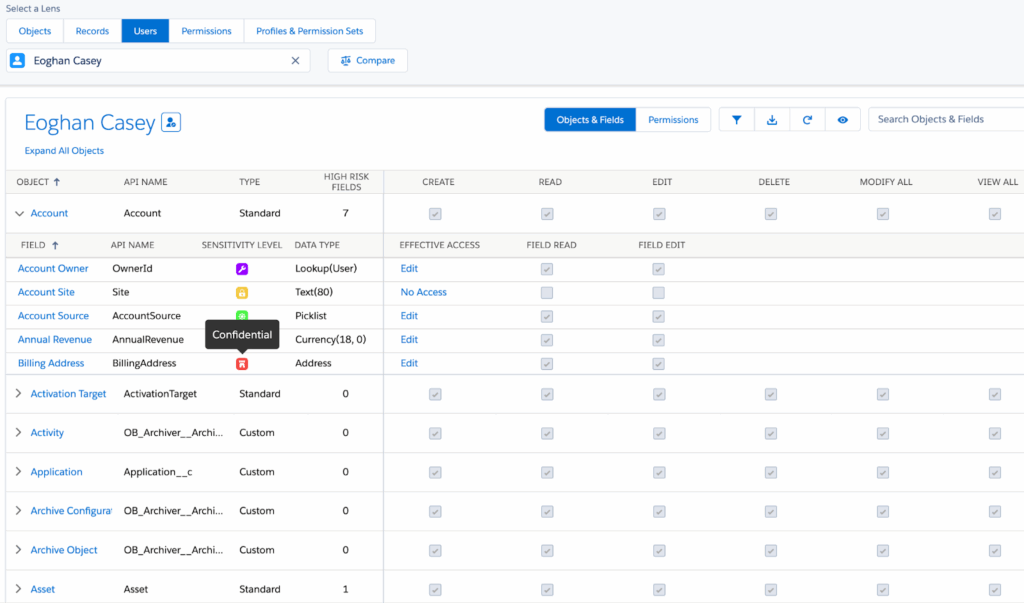
    WsW Explorer: Visualizing User Access
    WsW Explorer: Visualizing User Access

    By comparing ELF.ReportExport, ELO.ReportEventLog, and RTEM.ReportEventStream fields, investigators can pinpoint exactly which records and fields were accessed, with RTEM providing the most detailed context on queried entities and session parameters.

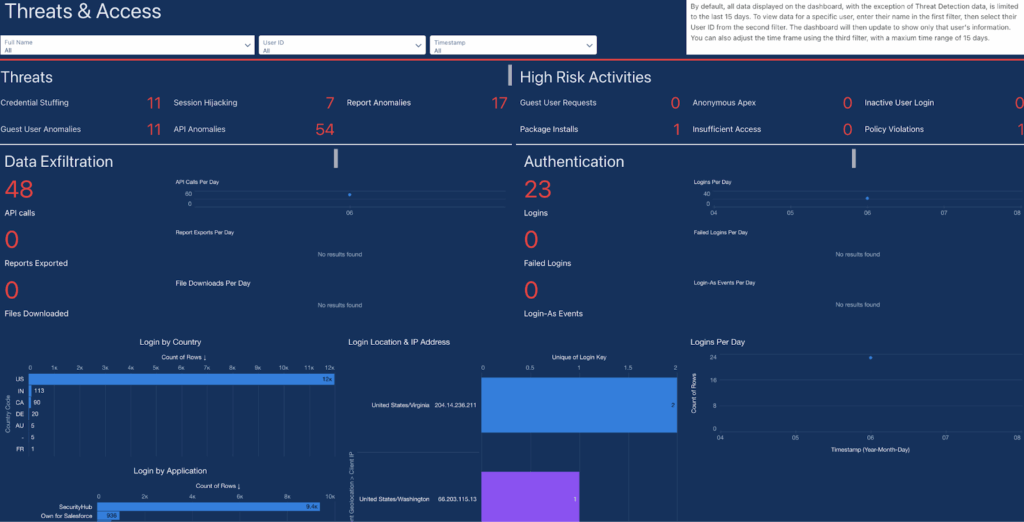
    Threats & Access dashboards
    Threats & Access dashboards

    Automated Response with Transaction Security Policies

    The guide also details how to leverage Enhanced Transaction Security Policies (TSP) to enact real-time countermeasures.

    Transaction Security Policies 

    Security teams can define policy rules to automatically block sensitive report downloads, trigger multi-factor authentication challenges, or create incident cases via workflow. For example, a Guest User Anomaly alert on a Digital Experience portal can activate a TSP that:

    • Blocks unauthorized AuraRequest events
    • Sends an immediate Slack notification
    • Requires MFA for any subsequent data access

    Such automation ensures that suspicious actions like abnormal API volumes or unexpected file exports are halted before data exfiltration can escalate.

    Organizations following the principle of least privilege across Profiles, Permission Sets, Sharing Rules, and Role Hierarchies will find forensic readiness significantly enhanced. 

    The guide recommends regular comparative analysis of backup snapshots using Backup & Recover, and continuous log streaming to centralized SIEM platforms for early anomaly detection.

    With the Salesforce Forensic Investigation Guide, enterprises are now armed to accelerate root-cause analysis, minimize downtime, and uphold data integrity in the face of evolving cloud-native threats.

    Find this Story Interesting! Follow us on Google NewsLinkedIn, and X to Get More Instant Updates.

    The post Salesforce Releases Forensic Investigation Guide Following Chain of Attacks appeared first on Cyber Security News.

    ¶¶¶¶¶

    ¶¶¶¶¶

    ¶¶¶¶¶

    ¶¶¶¶¶

    ¶¶¶¶¶

  • In a significant security move, Microsoft announced on August 26, 2025, that it will require mandatory multifactor authentication (MFA) for all accounts signing in to the Azure portal and related administrative centers. The policy, first introduced in 2024, aims to dramatically reduce account compromise by enforcing an additional layer of identity verification across Azure and […]

    The post Microsoft Enforces MFA for Logging into Azure Portal appeared first on GBHackers Security | #1 Globally Trusted Cyber Security News Platform.

    ¶¶¶¶¶

    ¶¶¶¶¶

    ¶¶¶¶¶

    ¶¶¶¶¶

    ¶¶¶¶¶

  • macOS has long been recognized for its robust, integrated security stack, but cybercriminals are finding ways to weaponize these very defenses.

     Recent incidents show attackers exploit Keychain, SIP, TCC, Gatekeeper, File Quarantine, XProtect, and XProtect Remediator to stealthily deliver malicious payloads. 

    Key Takeaways
    1. Abuse of macOS tools (Keychain, SIP, File Quarantine) for credential theft and evasion.
    2. Defense-evasion via disabling Gatekeeper, clickjacking TCC, and unloading XProtect.
    3. ESF logging with Sigma rules plus third-party EDR ensures detection.

    Exploiting Built-in macOS Protection

    Kaspersky reports that attackers have shifted from blunt-force exploits to nuanced abuse of legitimate tools and features. One common vector involves Keychain: adversaries use utilities like or the native /usr/bin/security list-keychains and security dump-keychain commands to harvest credentials.

    To detect such unauthorized usage, organizations must log process-creation events via ESF and flag invocations where cmdline matches security with -list-keychains or -dump-keychain. 

    A representative Sigma rule triggers on these patterns under attack.credential-access (T1555.001).

    System Integrity Protection (SIP) is another focus. Attackers boot into Recovery Mode to execute but they often probe SIP status first using csrutil status.

    Since Recovery Mode executions elude standard logs, defenders should implement continuous SIP status monitoring and generate alerts on state changes an approach aligned with Sigma rule T1518.001 under attack.discovery.

    Weaponizing File Quarantine, Gatekeeper, and TCC

    File Quarantine, which tags downloaded executables with the com.apple.quarantine attribute, can be bypassed by low-level tools such as curl or wget, or by invoking

     Leverage Built-in MacOS Protection Features

    Monitoring for xattr executions with -d com.apple.quarantine enables detection of quarantine-removal attempts (Sigma T1553.001 under attack.defense-evasion).

    Gatekeeper relies on code-signing and the spctl utility. Attackers may disable it or trick users into right-clicking an app to bypass signature checks, Kaspersky said.

    Alerting on spctl with –master-disable or –global-disable parameters uncovers these defense-evasion tactics (Sigma T1562.001).

    Transparency, Consent, and Control (TCC) governs access to the camera, microphone, and Full Disk Access through the SQLite-based TCC.db. 

    While modification requires disabling SIP or hijacking a system process, adversaries employ clickjacking overlays to trick users into granting elevated permissions. Continuous auditing of TCC.db changes and user prompts is crucial for early warning.

    Finally, XProtect and XProtect Remediator offer signature-based malware blocking and automatic remediation. 

    Sophisticated attackers attempt to disable or bypass these services by injecting unsigned kernel extensions (kexts) or abusing launchctl to unload Apple’s daemons. Defenders must track launchctl unload and unsigned-kext load attempts.

    Although macOS’s integrated security layers are formidable, attackers continuously evolve to exploit legitimate mechanisms. 

    Implementing detailed ESF-based logging, deploying Sigma rules for critical command patterns, and augmenting native defenses with third-party EDR solutions can effectively detect and thwart these advanced threats.

    Find this Story Interesting! Follow us on Google NewsLinkedIn, and X to Get More Instant Updates.

    The post Hackers Leverage Built-in MacOS Protection Features to Deploy Malware appeared first on Cyber Security News.

    ¶¶¶¶¶

    ¶¶¶¶¶

    ¶¶¶¶¶

    ¶¶¶¶¶

    ¶¶¶¶¶

  • Apple appears poised to remove the physical SIM card slot from its upcoming iPhone 17 models in more countries, with a significant rollout anticipated across the European Union. This change would mark the latest step in Apple’s long-term strategy of transitioning to the more secure and flexible eSIM technology, a move already implemented in the […]

    The post Apple May Drop Physical SIM Card in iPhone 17 appeared first on GBHackers Security | #1 Globally Trusted Cyber Security News Platform.

    ¶¶¶¶¶

    ¶¶¶¶¶

    ¶¶¶¶¶

    ¶¶¶¶¶

    ¶¶¶¶¶

  • Cybersecurity today is less about single attacks and more about chains of small weaknesses that connect into big risks. One overlooked update, one misused account, or one hidden tool in the wrong hands can be enough to open the door. The news this week shows how attackers are mixing methods—combining stolen access, unpatched software, and clever tricks to move from small entry points to large

    ¶¶¶¶¶

    ¶¶¶¶¶

    ¶¶¶¶¶

    ¶¶¶¶¶

    ¶¶¶¶¶

  • A high-severity vulnerability in SUSE’s Fleet, a GitOps management tool for Kubernetes clusters, has been disclosed by security researcher samjustus via GitHub Security Advisory GHSA-6h9x-9j5v-7w9h. The vulnerability, tracked as CVE-2024-52284, allows Helm chart values—often containing sensitive credentials—to be stored inside BundleDeployment resources in plain text, exposing them to any user with GET or LIST permissions. […]

    The post SUSE Fleet: Plain Text Storage of Vulnerability Exploit Helm Values appeared first on GBHackers Security | #1 Globally Trusted Cyber Security News Platform.

    ¶¶¶¶¶

    ¶¶¶¶¶

    ¶¶¶¶¶

    ¶¶¶¶¶

    ¶¶¶¶¶

  • A critical client-side remote code execution (RCE) vulnerability in Google Web Designer exposed Windows users to full system compromise, according to a detailed write-up by security researcher Balint Magyar. Affecting versions prior to 16.4.0.0711 (released July 29, 2025), the flaw allowed attackers to inject malicious CSS into a configuration file and leverage an internal API […]

    The post Google Web Designer Vulnerability Lets Hackers Take Over Client Systems appeared first on GBHackers Security | #1 Globally Trusted Cyber Security News Platform.

    ¶¶¶¶¶

    ¶¶¶¶¶

    ¶¶¶¶¶

    ¶¶¶¶¶

    ¶¶¶¶¶