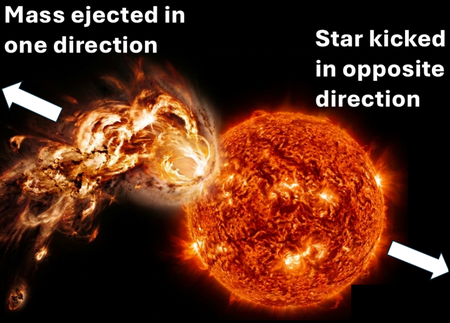
Scientists have discovered that dying stars don’t go down without a fight, with red giants spitting out blobs of plasma and receiving a corresponding “kick.”
Scientists have drawn up a research blueprint for assessing the viability of warming the Red Planet, outlining what it might take to make Mars a place in space where Earth life can thrive.
…
New research has failed to rule out self-annihilating dark matter as the source of a hotly debated gamma-ray emission known as the Galactic Center Excess radiating from the heart of the Milky Way.
…
A technique called echo mapping suggests supermassive black holes, like that at the heart of the Milky Way, are surrounded by clusters of dark matter.
…
An asteroid has been named after Smith, who died in 2003 at the age of 34.
Evidence of chemical alteration by liquid water has been found on the asteroid Donaldjohanson, which formed further from the sun before being shoved inwards.
…
Using the James Webb Space Telescope, astronomers have discovered that one of the coldest exoplanets ever discovered, the so-called Pink Planet, harbors a salty surprise.
…
“That’s what makes this field so exciting. You really are solving a mystery.”
Europe’s Mars Express orbiter recently imaged a huge valley system on the Red Planet — and dust devils dot the alien landscape.
…
A new study reveals why black holes let out massive radio “burps” years after eating stars, giving astronomers a chemical blueprint to predict them early.
…